Lifting After 40/ September 7, 2026/ 6 min read
How Many Days a Week Should a 45-Year-Old Lift Weights?


Three days a week, arranged so every muscle gets trained twice. Schoenfeld, Ogborn and Krieger found twice-weekly training per muscle beat once weekly at equal volume, effect size 0.49 against 0.30. The number that matters is sessions per muscle, not sessions per week. Two days works. Four is better if you shorten each one.
The Physical Activity Guidelines for Americans, second edition, set the floor at muscle-strengthening activity on two or more days a week. Schoenfeld’s meta-analysis in Sports Medicine pushed past that floor with a hard finding: with weekly volume held equal, twice-weekly training per muscle produced an effect size of 0.49 against 0.30 for once weekly, p equals 0.002. Currier and colleagues, pooling 119 hypertrophy studies for the British Journal of Sports Medicine, ranked higher-load multiset twice-weekly training highest of all twelve prescriptions they tested.
How many days a week should a 45-year-old lift weights?
Three. Two full-body days works and beats nothing by a wide margin. Four days beats three if you keep the total weekly sets the same and just spread them thinner. Five is a scheduling problem pretending to be a training question.
Nothing in that answer is age-specific, and that is the point most pages get wrong. There is no study showing 45-year-olds need a different number of weekly sessions than 25-year-olds. What the research shows is a smaller response to the same dose. Morton and colleagues measured the fat-free mass benefit dropping 0.01 kg per year of age, p equals 0.002.
A smaller response argues for keeping the dose, not shrinking it. So the frequency answer for a 45-year-old is the frequency answer for anyone, delivered in shorter sessions. The full case sits in our pillar on lifting after 40.
Why is frequency per muscle the number that matters?
Because “three days a week” describes your calendar, not your chest. A three-day full-body week trains every muscle three times. A three-day bro split trains every muscle once. Those are the same number of gym visits and completely different programs.
Schoenfeld, Ogborn and Krieger were explicit about the mechanism. The frequency advantage held when weekly volume was equated, which means twice-weekly training is not better because you do more work, it is better because the same work lands in two doses instead of one. Their separate dose-response meta-analysis in the Journal of Sports Sciences established the volume half of the equation: each additional weekly set was worth 0.37 percent more growth, with a 3.9 percent gap between higher and lower volume conditions.
So there are two numbers. Weekly sets per muscle drives how much you grow. Sessions per muscle drives how efficiently those sets convert. Days per week is downstream of both.
What do 2, 3 and 4-day weeks actually give you?
Each structure caps how many sets a muscle can absorb before the session gets too long to finish well. That cap is the real difference between them. A two-day week has to fit ten to twelve sets per muscle into two sessions. A four-day week gets to spread the same total across four.
| Structure | Times each muscle is trained | Sets per muscle per week | Session length |
|---|---|---|---|
| 2 days, full body | 2 | 8 to 10 | 60 to 75 minutes |
| 3 days, full body | 3 | 9 to 12 | 50 to 65 minutes |
| 3 days, upper / lower / full | 2 | 10 to 14 | 50 to 65 minutes |
| 4 days, upper / lower | 2 | 12 to 18 | 40 to 55 minutes |
| 4 days, push / pull / legs / full | 2 | 12 to 16 | 40 to 55 minutes |
| 3 days, one body part per day | 1 | 6 to 8 | 60 minutes |
Look at the last row. Three gym visits, the worst outcome on the table, because every muscle waits a full week between sessions and the weekly set count collapses. That is the split most 45-year-olds inherited from a magazine and it is the one to abandon first.
What conditions move the number up or down?
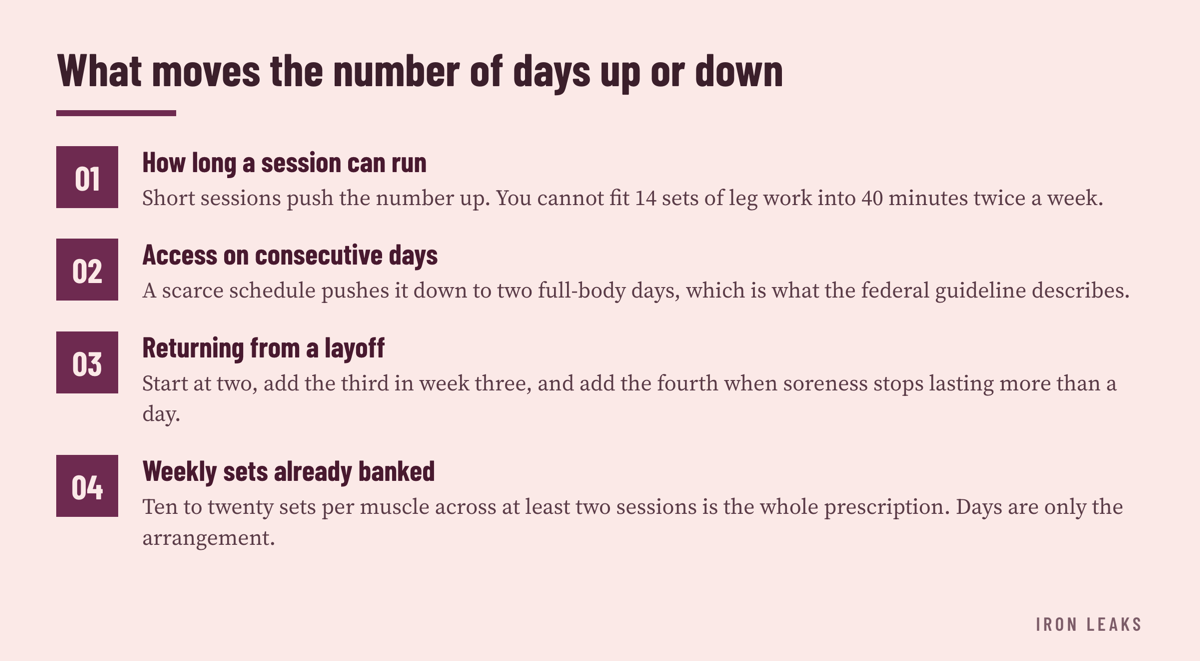
Four things, in order of how much they matter. How much time each session can run. Whether you can get to a gym or a rack on consecutive days. Whether you are returning from a layoff. And whether your total weekly sets are already in the 10 to 20 range.
Short sessions push the number up. If you only have 40 minutes, four days is not ambitious, it is arithmetic: you cannot fit 14 sets of leg work into 40 minutes twice a week. Long sessions and a scarce schedule push it down to two full-body days, which is a genuinely good program and is what the federal guideline describes.
A layoff pushes it down temporarily. Start at two, add the third in week three, add the fourth when the soreness after each session stops lasting more than a day. How much space to leave between sessions as you add them is worked through in how many rest days a 50-year-old needs between workouts. If your week refuses to hold a fixed pattern at all, training around a schedule that fights you handles the irregular case.
Does being 45 change the answer at all?
It changes the shape of the sessions, not the count. Peterson, Rhea, Sen and Gordon’s meta-analysis of 47 studies in adults over 50 found strength gains of 9.8 to 31.6 kg, and their lean-mass companion paper found higher-volume programs produced significantly greater gains, beta equals 0.05, p under 0.01. Volume still pays at that age. Nobody has shown a lower optimal frequency.
What does change is warm-up time. Fradkin, Zazryn and Smoliga’s review of 32 studies found warm-up improved performance in 79 percent of criteria examined. Budget 12 to 20 minutes before your first heavy set at 45, not 5. That warm-up cost is fixed per session, which is a real argument for three days over five.
Every one of those warm-ups is time you are not doing work sets. Five sessions a week means 100 minutes of warm-up. That is the honest trade.
What if you can only train twice a week?
Then train twice a week, full body, and stop apologizing. Two sessions trains every muscle twice, which is the frequency Schoenfeld’s meta-analysis found sufficient to capture the frequency effect. It also meets the Physical Activity Guidelines for Americans threshold exactly.
Make each session count with compound lifts. A squat or leg press, a horizontal press, a vertical or horizontal pull, a hinge, and one arm or shoulder movement covers the body in five exercises. Three to four sets each puts you at 8 to 10 weekly sets per muscle, which is inside the range where Schoenfeld’s dose-response curve is still climbing steeply.
The failure mode of a two-day week is not the frequency. It is skipping one. Two days a week with one missed session is one day a week, and one day a week is the condition that lost in the frequency meta-analysis. We explain how we weight evidence like this on our research methodology page.
What would I actually have a 45-year-old do?
Four days, upper and lower, alternating, roughly 45 minutes each. That is my answer even though three days is the correct general recommendation, and the reason is specific.
At 45 the fixed cost of a session goes up because the warm-up goes up. Once you are already paying 15 minutes to warm up, a 45-minute session and a 75-minute session cost nearly the same in hassle but the 45-minute one gets finished on the days you do not feel like going. Four short sessions produce the highest weekly set totals of anything on the table above, at 12 to 18 sets per muscle, and they do it with the least fatigue per session.
The catch is honest: four days needs four gym-accessible days, and most people do not have them. If you have three, do three. If you have two, do two full-body days and get on with it. Whether a total beginner should start with any of this is covered in is it too late to start lifting at 45, and how fast the first months move is in do newbie gains still happen after 40.
The one number to write down
Count sets per muscle per week, not days. Ten to twenty weekly sets per muscle, delivered in at least two sessions, is the whole prescription. Everything else on this page is a way of arranging that number around your calendar. If a program change raises your weekly sets and keeps the frequency at two, it is an upgrade regardless of how many days it uses.
One caveat that applies to all of it: this is general training information for healthy adults. Pain that shows up on a specific movement and stays is a question for a clinician, not a reason to change your split.
Questions readers actually ask
How many days a week should a 45-year-old lift weights?
Three days, arranged so every muscle is trained twice a week. Two full-body days is a legitimate program and meets the Physical Activity Guidelines for Americans floor of muscle-strengthening on two or more days. Four shorter sessions beat three long ones if your schedule allows.
Is three days a week enough to build muscle at 45?
Yes, provided the split trains each muscle at least twice. Three full-body days or an upper, lower and full-body rotation delivers 9 to 14 sets per muscle per week, which sits inside the range where Schoenfeld's dose-response curve still climbs.
Should a 45-year-old train fewer days than a 25-year-old?
No. No study shows a lower optimal weekly frequency with age. What changes is session length and warm-up time. Keep the weekly set total and split it across more, shorter sessions rather than cutting the number of days.
Why is a body-part split a bad choice at 45?
Because it trains each muscle once a week. Schoenfeld's meta-analysis found once-weekly training produced an effect size of 0.30 against 0.49 for twice weekly at equal volume. A three-day body-part split also collapses weekly sets per muscle to 6 to 8.
How long should each session be at 45?
Forty to seventy-five minutes depending on how many days you train, plus a 12 to 20 minute warm-up before the first heavy set. That warm-up is a fixed cost per session, which is the strongest practical argument against training five or six days a week.
Sources
- Schoenfeld BJ, Ogborn D, Krieger JW. Effects of resistance training frequency on measures of muscle hypertrophy: a systematic review and meta-analysis. Sports Medicine 2016. Twice-weekly training per muscle beat once weekly at equated volume, effect size 0.49 against 0.30, p equals 0.002.
- Schoenfeld BJ, Ogborn D, Krieger JW. Dose-response relationship between weekly resistance training volume and increases in muscle mass. Journal of Sports Sciences 2017. Each additional weekly set worth 0.37 percent more growth; 3.9 percent difference between higher and lower volume conditions.
- Currier BS et al. Resistance training prescription for muscle strength and hypertrophy in healthy adults: a systematic review and Bayesian network meta-analysis. British Journal of Sports Medicine 2023. 178 strength and 119 hypertrophy studies; higher-load multiset twice-weekly ranked highest for hypertrophy.
- Piercy KL et al. The Physical Activity Guidelines for Americans. JAMA 2018. Adults should do muscle-strengthening activities on 2 or more days a week.
- Peterson MD, Rhea MR, Sen A, Gordon PM. Resistance exercise for muscular strength in older adults: a meta-analysis. Ageing Research Reviews 2010. 47 studies in adults 50 and over; strength gains of 9.8 to 31.6 kg, greater with higher intensity.
- Fradkin AJ, Zazryn TR, Smoliga JM. Effects of warming-up on physical performance: a systematic review with meta-analysis. Journal of Strength and Conditioning Research 2010. 32 studies; warm-up improved performance in 79 percent of criteria examined.
Links last checked September 7, 2026.
Every figure above is traced to a named source and re-checked on a monthly cycle. Read how we research.
Independence note. Iron Leaks takes no money from supplement brands, equipment makers or gym chains, and carries no affiliate links. Nothing here is medical advice.
Cole Brennan
Cole Brennan has trained in home gyms since 2013 and has coached lifters through the exact constraints this site is about: one pair of adjustable dumbbells, a low ceiling, a downstairs neighbour, and nobody to spot. He built Iron Leaks after watching the biggest fitness sites answer every question except the one a reader with limited equipment and limited time actually asked. He reads the primary literature rather than other people's summaries of it, and every number he publishes carries a link to where it came from. He is not a doctor and does not pretend to be one.
Keep reading
Is It OK To Lift Heavy Weights After 40?
Real load numbers instead of opinion: what percentage of your max counts as heavy after 40, and why the rate you add…
How Many Rest Days Does a 50-Year-Old Need Between Workouts?
Rest is measured per muscle group, not in days off per week. Two weekly layouts that give every muscle 48 hours, and…