Yes. The National Strength and Conditioning Association’s 2019 position statement on resistance training for older adults recommends 70 to 85 percent of one-rep max, 1 to 3 sets per exercise, on 2 to 3 nonconsecutive days per week per muscle group. Heavy is the prescription, not the hazard. What needs controlling is how fast you add load, because tendon adapts slower than muscle.
The numbers are published and they are not conservative. Fragala and colleagues, writing the NSCA position statement on resistance training for older adults, put the strength-building intensity at 70 to 85 percent of 1RM and the frequency at 2 to 3 nonconsecutive days per week per muscle group. The ACSM position stand on progression models goes further for trained lifters: 1 to 12 RM in a periodized fashion, with eventual emphasis on 1 to 6 RM and 3 to 5 minute rest periods. Peterson’s 2010 meta-analysis in Ageing Research Reviews, covering 47 studies and 1,079 adults aged 50 and over, found higher intensity training was associated with greater improvement, with strength gains of 29 percent on leg press and 33 percent on knee extension.
Is it OK to lift heavy weights after 40?
It is, and the position statements say so in numbers rather than in reassurance. The NSCA statement puts the target intensity at 70 to 85 percent of 1RM for healthy older adults and lists free-weight training with barbells, dumbbells and kettlebells as an added benefit for high-functioning older adults. Nothing in it caps load by birthday.
The statement does add one operational note worth repeating: joint stress and soreness should be monitored when training at high intensities. It also observes that repetitions to failure are not necessary and do not promote additional adaptation in older individuals. So heavy, yes. Heavy to failure every session, no.
The one real limit is medical rather than chronological. If you have uncontrolled blood pressure, chest symptoms, or a joint problem that is getting worse rather than better, that is a conversation with a clinician before it is a programming question. This article is about load selection for healthy adults, not a treatment plan.
What counts as heavy after 40?
Heavy is a percentage, not a weight. The published prescriptions cluster in two bands: a strength band around 70 to 85 percent of 1RM, and a power band around 40 to 60 percent of 1RM moved fast on the concentric. Both come from the same NSCA document. The ACSM stand adds repetition-maximum zones for people who do not test a 1RM.
| Goal | Load | Sets and rest | Source |
|---|---|---|---|
| Strength, healthy older adults | 70 to 85 percent of 1RM | 1 to 3 sets per exercise | NSCA position statement |
| Power, healthy older adults | 40 to 60 percent of 1RM, fast concentric | 1 to 3 sets per exercise | NSCA position statement |
| Novice, healthy adults | 8 to 12 RM | 2 to 3 days per week | ACSM progression stand |
| Intermediate to advanced | 1 to 12 RM, periodized, emphasis on 1 to 6 RM | 3 to 5 minutes between sets | ACSM progression stand |
| Size emphasis | 6 to 12 RM | 1 to 2 minutes between sets | ACSM progression stand |
Read the rest column. The reason a heavy triple feels reckless to most 45-year-olds is that they take 90 seconds between sets and then try to hit it. ACSM specifies 3 to 5 minutes for the 1 to 6 RM zone. Underresting a heavy set is a far more common error than the load itself.
Why is the rate of load increase the real risk, not the load?
Because muscle and tendon do not adapt on the same clock. Mersmann, Bohm and Arampatzis, reviewing tendon overload in Frontiers in Physiology, state it plainly: muscle and tendon differ in both the time course of adaptation to mechanical loading and the responsiveness to particular types of stimulus. A muscle that got 8 percent stronger in three weeks is attached to a tendon that did not.
The same group’s meta-analysis of 27 tendon loading studies in Sports Medicine Open found a standardized effect of 0.70 for tendon stiffness but only 0.24 for cross-sectional area, and that stiffness adaptation depended significantly on loading intensity. Interventions of 12 weeks or longer produced the larger effect. Tendon responds to heavy loading. It just wants more weeks of it.
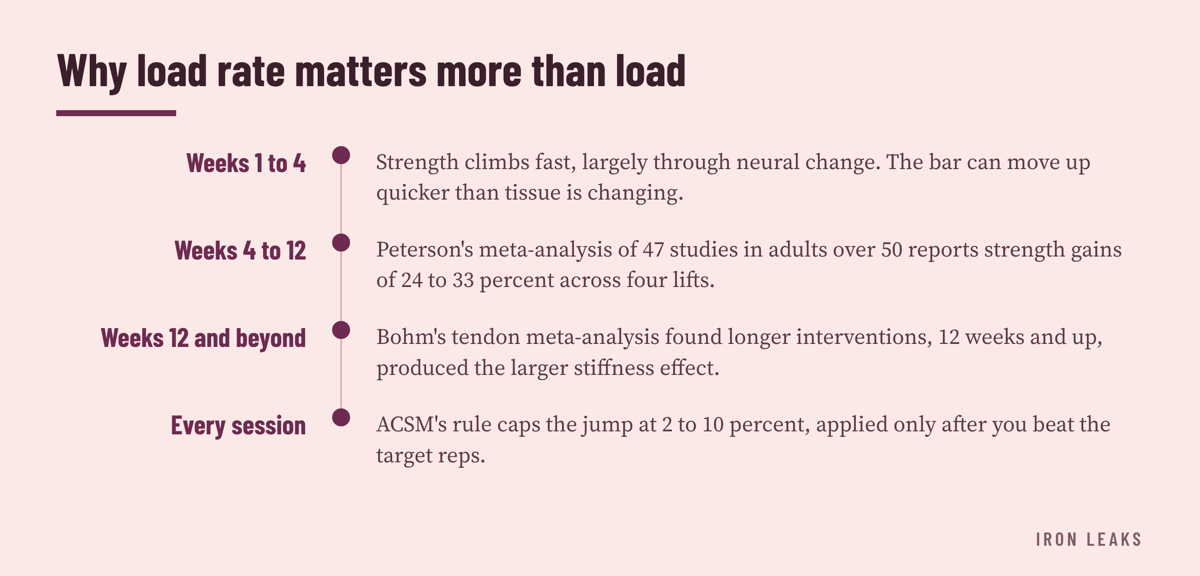
So the argument was never heavy against light. It is bar speed of progression against tissue speed of adaptation. ACSM gives the governor: increase the load by 2 to 10 percent once you can perform the current workload for one to two repetitions beyond the target.
Heavy is a percentage you earned. Reckless is a percentage you jumped to.
How fast should you actually add weight after 40?
ACSM’s window is 2 to 10 percent. That is a wide window and the top of it is where people over 40 get into trouble. Ten percent on a 315 pound squat is a 31 pound jump in one session.
The editor’s judgement, stated as judgement and not as a finding: take the bottom of the ACSM window on the big compounds and the top of it on small isolation work. A 2.5 to 5 percent jump on squat, deadlift and press, applied only after you clear the target reps in two consecutive sessions, gives you roughly the same annual load increase with a fraction of the week-to-week spikes. On curls and lateral raises the absolute numbers are small enough that 10 percent is a single dumbbell increment.
That is a rate rule, not a ceiling rule. Nothing here says stop at a number. The same method applies to the reps and set counts covered in our guide to knowing whether you are progressing without adding weight.
How much volume goes with heavy work?
Less than you would guess, and the sources disagree usefully. The NSCA statement lists 1 to 3 sets per exercise per muscle group, with 1 set for beginners. It cites Borde’s meta-analysis, in which 2 to 3 sets per exercise and 7 to 9 repetitions produced the largest effects on both strength and muscle morphology in older adults.
Against that, Schoenfeld, Ogborn and Krieger’s dose-response meta-analysis in the Journal of Sports Sciences reports a graded relationship in the general adult literature: each additional weekly set was associated with a 0.37 percent greater gain, and higher-volume conditions beat lower-volume conditions by 3.9 percent. Peterson’s 2011 meta-analysis in Medicine and Science in Sports and Exercise found higher-volume programs produced significantly greater lean body mass gains in adults over 50, with a pooled change of 1.1 kg.
The practical read: heavy sets are where volume gets expensive. Keep the 80-plus percent work to the low end of the set range and put the extra sets in the 65 to 75 percent range where recovery cost is lower. How much recovery that buys you is the subject of how many rest days a 50-year-old needs between workouts.
Which lifts stay heavy and which do not?
Keep heavy anything you can bail out of and anything where the failure mode is dropping the weight rather than folding under it. Trap bar deadlift, leg press, machine rows, dumbbell press, weighted chin-ups. These take 85 percent cleanly.
Be more selective with barbell back squats to depth, conventional deadlifts from the floor, and behind-the-neck pressing. Not because the load is dangerous but because the position is unforgiving and the margin for a rep that goes wrong is thin. If squatting deep under a heavy bar is the sticking point, the substitutions are covered in training legs after 40 without heavy squats.
The one non-negotiable
Every heavy set needs an exit. A safety pin height you have tested empty, a rack you can dump into, or a load you can set down. The solo squat setup covers the pin height method. Absent an exit, drop to a load you would be happy failing with.
Does heavy lifting fit the national activity guidelines?
It is the guideline. Piercy and colleagues, summarizing the second edition of the Physical Activity Guidelines for Americans in JAMA, state that adults should do muscle-strengthening activities on 2 or more days a week, and that older adults should add balance training to their aerobic and muscle-strengthening work. Two heavy sessions a week clears the federal bar with room to spare, and how many days a week a 45-year-old should lift works out where to land above that minimum.
That is the floor, not the target. The full picture of what frequency, load and recovery look like together is in our pillar on lifting after 40, and the way we pick and check sources is on the methodology page.
Questions readers actually ask
What percentage of my max counts as heavy after 40?
The NSCA position statement on resistance training for older adults puts strength-building intensity at 70 to 85 percent of one-rep max. The ACSM progression stand allows trained lifters to work as heavy as 1 to 6 RM in a periodized plan.
How fast should I add weight to the bar after 40?
The ACSM position stand says increase the load by 2 to 10 percent once you can perform the current workload for one to two repetitions beyond your target. On big compound lifts, the low end of that window is the safer default.
Is lifting to failure necessary after 40?
No. The NSCA position statement says repetitions to failure are not necessary and do not promote additional physiological adaptations in older individuals. It also advises monitoring joint stress and soreness when training at high intensities.
How many heavy sets should I do per exercise?
The NSCA lists 1 to 3 sets per exercise per muscle group, with 1 set for beginners. It cites evidence that 2 to 3 sets of 7 to 9 repetitions produced the largest strength and size effects in older adults.
How much rest do I need between heavy sets?
The ACSM progression stand specifies 3 to 5 minutes between sets in the 1 to 6 RM zone, and 1 to 2 minutes when the emphasis is muscle size at 6 to 12 RM. Underresting heavy sets is a more common error than the load itself.
Sources
- Fragala et al., Resistance Training for Older Adults: Position Statement From the NSCA, Journal of Strength and Conditioning Research 2019. Source of the 70 to 85 percent of 1RM intensity, 1 to 3 sets, and 2 to 3 nonconsecutive days per muscle group.
- ACSM Position Stand: Progression Models in Resistance Training for Healthy Adults, Medicine and Science in Sports and Exercise 2009. Source of the RM zones, the 3 to 5 minute heavy rest periods, and the 2 to 10 percent load-increase rule.
- Peterson et al., Resistance exercise for muscular strength in older adults: a meta-analysis, Ageing Research Reviews 2010. 47 studies, 1079 adults aged 50 and over; higher intensity training associated with greater strength improvement.
- Peterson et al., Influence of resistance exercise on lean body mass in aging adults, Medicine and Science in Sports and Exercise 2011. 49 studies; pooled lean body mass change of 1.1 kg, with higher-volume programs producing greater gains.
- Bohm, Mersmann and Arampatzis, Human tendon adaptation in response to mechanical loading, Sports Medicine Open 2015. Meta-analysis of 27 studies; tendon stiffness adaptation depends on loading intensity, larger effects with interventions of 12 weeks or more.
- Mersmann, Bohm and Arampatzis, Imbalances in the Development of Muscle and Tendon, Frontiers in Physiology 2017. Review stating that muscle and tendon differ in the time course of adaptation to mechanical loading.
Links last checked September 7, 2026.
Every figure above is traced to a named source and re-checked on a monthly cycle. Read how we research.
Independence note. Iron Leaks takes no money from supplement brands, equipment makers or gym chains, and carries no affiliate links. Nothing here is medical advice.

Cole Brennan
Cole Brennan has trained in home gyms since 2013 and has coached lifters through the exact constraints this site is about: one pair of adjustable dumbbells, a low ceiling, a downstairs neighbour, and nobody to spot. He built Iron Leaks after watching the biggest fitness sites answer every question except the one a reader with limited equipment and limited time actually asked. He reads the primary literature rather than other people's summaries of it, and every number he publishes carries a link to where it came from. He is not a doctor and does not pretend to be one.
Keep reading
How Many Rest Days Does a 50-Year-Old Need Between Workouts?
Rest is measured per muscle group, not in days off per week. Two weekly layouts that give every muscle 48 hours, and…
How Many Days a Week Should a 45-Year-Old Lift Weights?
A real number with the reasoning behind it, plus a table of 2, 3 and 4-day weeks showing what each one actually…