
Yes. Untrained people in their forties, sixties and seventies all add muscle in controlled trials. The response is somewhat smaller with age, but the effect is modest and inconsistent between studies. Morton and colleagues measured the drop at 0.01 kg of fat-free mass per year of age. That is 0.2 kg across two decades.
Morton and colleagues, pooling 49 randomized trials with 1,863 participants in the British Journal of Sports Medicine, found the fat-free mass benefit of protein supplementation fell by 0.01 kg per year of age, p=0.002. Peterson, Sen and Gordon pooled 49 studies of 1,328 adults over 50 in Medicine and Science in Sports and Exercise, reported a mean gain of 1.1 kg of lean body mass, and found older participants gained less, with a meta-regression coefficient of minus 0.03 at p=0.01.
Both findings point the same way. Neither is large. And here is the awkward part nobody mentions: almost none of this research studied people in their forties. The comparisons are twenty-somethings against sixty- and seventy-somethings, and the forties get interpolated.
Do newbie gains still happen after 40?
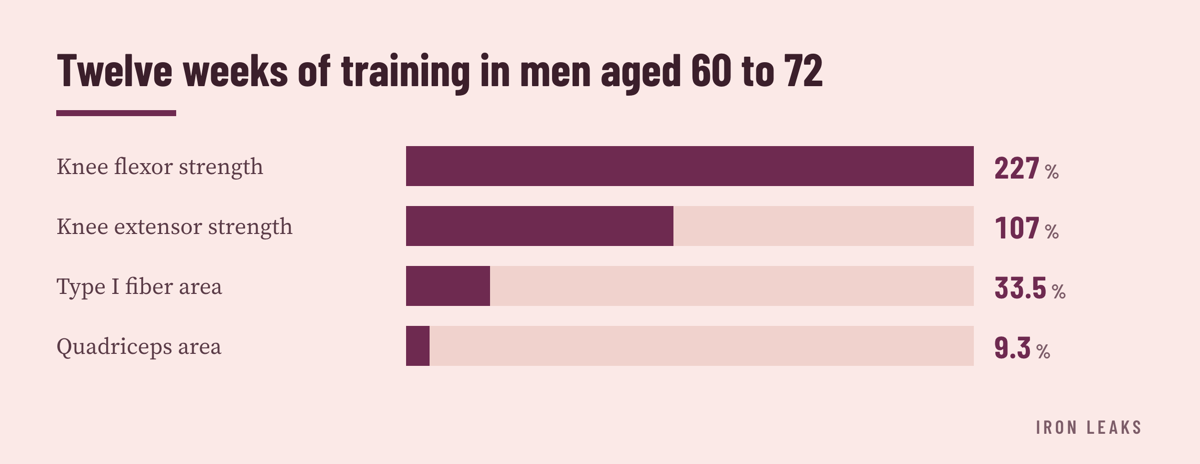
They do, and the trials are unambiguous about it. Frontera and colleagues trained twelve untrained men aged 60 to 72 for 12 weeks in the Journal of Applied Physiology. Knee extensor strength rose 107%, flexor strength 227%, quadriceps area 9.3%, and type I fiber area 33.5%.
Those are beginner-scale numbers in men decades past 40. Roth and colleagues ran six months of whole-body training on young and older men and women in the Journal of the American Geriatrics Society and found thigh and quadriceps volume rose significantly in every group with no significant differences between them.
So the honest framing is not whether the newbie phase exists after 40. It is how much smaller it runs, and the answer to that is less clear than you would expect.
What does the research on age and training response show?
It splits. Roughly half the well-controlled comparisons find an age penalty on muscle size and roughly half do not. The studies that find one tend to measure individual fibers or specific muscle groups. The studies that find none tend to measure whole-limb volume over longer periods.
| Study | Comparison | Duration | Effect of age |
|---|---|---|---|
| Welle, Totterman and Thornton, J Gerontol 1996 | 9 adults aged 22 to 31 vs 8 aged 62 to 72 | 3 months | Elbow flexor area +22% young vs +9% older; knee extensors +4% vs +6% |
| Kosek et al., J Appl Physiol 2006 | 24 adults aged 20 to 35 vs 25 aged 60 to 75 | 16 weeks, 3 days a week | Mean type II fiber +32% young vs +23% older; type I rose in young only |
| Roth et al., J Am Geriatr Soc 2001 | 14 adults aged 20 to 30 vs 19 aged 65 to 75 | 6 months | Thigh and quadriceps volume rose in all groups, no significant age difference |
| Ahtiainen et al., Age 2016 | 287 untrained adults aged 19 to 78 | Pooled trials | Mean size change +4.8%, range -11% to +30%; age did not predict response |
| Peterson, Sen and Gordon, Med Sci Sports Exerc 2011 | 1,328 adults aged 50 and over, 49 studies | Mixed durations | Pooled +1.1 kg lean body mass; older participants gained less, beta -0.03 |
| Morton et al., Br J Sports Med 2018 | 1,863 adults, 49 randomized trials | 6 weeks and longer | Protein supplementation benefit fell 0.01 kg of fat-free mass per year of age |
How big is the age penalty in real numbers?
Small enough that it should not change your plan. Take the Morton coefficient literally. A 45-year-old and a 25-year-old differ by 20 years, so 0.01 kg per year makes a 0.2 kg difference in the fat-free mass benefit from supplementing protein. That is less than half a pound over two decades of age.
The fiber-level differences look bigger in percentage terms. Kosek and colleagues found mean type II fiber size rose 32% in the young group and 23% in the older group over 16 weeks in the Journal of Applied Physiology. Type I fibers grew 18% in the young group and did not reach significance in the older one.
But those comparisons pit 20-to-35 against 60-to-75. Nothing in that design tells you what happens at 43. We flag this kind of gap explicitly, which is covered in how we research.
Does the penalty hit every muscle equally?
No, and this is the most useful finding in the whole literature. Welle, Totterman and Thornton scanned nine young and eight older adults by MRI over three months of training, reported in the Journals of Gerontology. Elbow flexor area rose 22% in the young group against 9% in the older one.
Knee flexors showed the same pattern, 8% against 1%. Knee extensors did not: 4% in the young group, 6% in the older group. The quadriceps, the biggest muscle group most beginners train hardest, showed no penalty at all.
Welle’s group also found training-induced increases in specific tension, which is strength per unit of cross-sectional area, were equal in both age groups for elbow flexors and knee extensors, and actually larger in the older group for knee flexors.
The quadriceps, the muscle group most beginners train hardest, showed no age penalty at all.
Does strength respond differently from size after 40?
Strength holds up far better than size does. Fiatarone and colleagues trained frail nursing home residents averaging 87 years old for ten weeks in the New England Journal of Medicine. Muscle strength rose 113%. Thigh muscle area rose 2.7% and missed statistical significance.
That dissociation runs through the whole age literature. The strength curve after 40 is close to the strength curve at 25 for a beginner, because most early strength is neural rather than structural. The size curve is the one that flattens.
If you are judging progress by the mirror rather than the logbook after 40, you are watching the slower of the two variables. Our piece on how long results take at 50 separates those timelines properly.
What the numbers do not cover
The direct young-versus-old comparisons in this article studied people in their twenties against people in their sixties and seventies. We could not find a controlled trial that isolated 40 to 49 year old beginners against a younger group. Any claim about what specifically happens at 42 is interpolation, including ours.
Are there non-responders after 40?
Not according to the largest analysis that looked for them. Churchward-Venne and colleagues re-analyzed 110 adults over 65 at 12 weeks and 85 at 24 weeks in JAMDA, under the title “There Are No Nonresponders to Resistance-Type Exercise Training in Older Men and Women”.
Lean body mass rose 0.9 kg at 12 weeks and 1.1 kg at 24 weeks. The individual range was enormous, from minus 3.3 kg to plus 5.4 kg at 12 weeks. Every single participant improved on at least one outcome, and responsiveness improved with longer interventions.
Ahtiainen and colleagues found the same spread in 287 untrained adults aged 19 to 78 in Age. Mean muscle size change was 4.8%, individual results ranged from minus 11% to plus 30%, and age did not predict where anyone landed.
Does protein matter more after 40?
The evidence says it matters slightly less, not more, which surprises most people. The PROT-AGE position paper in JAMDA recommends at least 1.0 to 1.2 g/kg/day, and 1.2 g/kg/day or more for those exercising, but it was written for people over 65 and should not be read as a 45-year-old’s prescription.
For an exercising adult under 65, the ISSN position stand range of 1.4 to 2.0 g/kg/day applies at 45 exactly as it does at 25. Morton’s break-point analysis found no additional fat-free mass above a total intake of 1.62 g/kg/day at any age.
Getting there is a logistics problem, not a physiology problem. We cover the cheap version in hitting 150g of protein on a budget.
What should a 40-something beginner actually do?
Train as if the penalty does not exist, because at your age it barely does. Here is the judgement call: the age adjustments that dominate over-40 fitness content are almost all recovery advice, not stimulus advice, and lowering the stimulus is the one change the data does not support.
Frontera’s 60-to-72-year-olds trained at 80% of one-rep max, three sets of eight, three days a week, and doubled their leg strength in twelve weeks. Nothing in that protocol is gentle. Start there, add sets before you add days, and give the first block sixteen weeks before you judge it against how much muscle a 40-year-old adds in six months rather than against a younger lifter.
For the full picture on rate, read our pillar on how much muscle you can build naturally. If you are weighing whether to start at all, we answered that question directly, and lifting after 40 covers frequency and recovery.
Questions readers actually ask
Do newbie gains still happen after 40?
Yes. Frontera and colleagues trained untrained men aged 60 to 72 for 12 weeks and saw knee extensor strength rise 107 percent and quadriceps area rise 9.3 percent. Beginner-scale responses are documented well past 40.
How much smaller are muscle gains after 40?
Modestly smaller and inconsistently so. Morton and colleagues measured a fall of 0.01 kg of fat-free mass per year of age, which is 0.2 kg across two decades. Roth and Ahtiainen found no significant age effect at all.
Does age affect every muscle the same way?
No. Welle and colleagues found elbow flexor area rose 22 percent in young adults against 9 percent in older ones, but knee extensors rose 4 percent in the young group and 6 percent in the older group. The quadriceps showed no penalty.
Are there non-responders to lifting after 40?
Churchward-Venne and colleagues analyzed 110 adults over 65 and found every participant improved on at least one outcome. Lean body mass rose 0.9 kg at 12 weeks and 1.1 kg at 24 weeks, with a wide individual range.
Should someone over 40 train less hard?
The data does not support lowering the stimulus. Frontera's participants aged 60 to 72 trained at 80 percent of one-rep max, three sets of eight, three days a week, and roughly doubled leg strength in twelve weeks.
Sources
- Morton et al., British Journal of Sports Medicine 2018. Meta-analysis of 49 randomized trials; fat-free mass benefit of protein supplementation fell 0.01 kg per year of age
- Welle, Totterman and Thornton, Journals of Gerontology 1996. MRI comparison of training response in adults aged 22 to 31 against 62 to 72 over three months
- Kosek et al., Journal of Applied Physiology 2006. Sixteen weeks of three-day-a-week training compared in adults aged 20 to 35 and 60 to 75
- Roth et al., Journal of the American Geriatrics Society 2001. Six months of whole-body training found no significant age difference in thigh or quadriceps muscle volume gains
- Frontera et al., Journal of Applied Physiology 1988. Twelve weeks of training in untrained men aged 60 to 72 produced 107 percent knee extensor strength gain
- Churchward-Venne et al., JAMDA 2015. Every participant over 65 improved on at least one outcome; lean body mass rose 0.9 kg at 12 weeks
Links last checked September 7, 2026.
Every figure above is traced to a named source and re-checked on a monthly cycle. Read how we research.
Independence note. Iron Leaks takes no money from supplement brands, equipment makers or gym chains, and carries no affiliate links. Nothing here is medical advice.

Cole Brennan
Cole Brennan has trained in home gyms since 2013 and has coached lifters through the exact constraints this site is about: one pair of adjustable dumbbells, a low ceiling, a downstairs neighbour, and nobody to spot. He built Iron Leaks after watching the biggest fitness sites answer every question except the one a reader with limited equipment and limited time actually asked. He reads the primary literature rather than other people's summaries of it, and every number he publishes carries a link to where it came from. He is not a doctor and does not pretend to be one.
Keep reading
How Much Muscle Can a 40-Year-Old Gain in 6 Months?
What six-month resistance training trials actually measured, why the second three months add far less than the first, and the range worth…
Can You Build Muscle and Lose Fat at the Same Time After 40?
Body recomposition is real, but the conditions decide it. What five controlled trials show about who gains muscle while losing fat, and…