Home and Minimal Equipment/ September 8, 2026/ 7 min read
How To Squat Heavy at Home Without a Spotter

Set safety pins one inch below the lowest point your bar reaches, rehearse the bail-out with an empty bar, and squat alone at two to three reps in reserve. Pins catch a failed squat. A spotter cannot lift a loaded bar off you from the bottom. With no rack and no safeties, do not back squat heavy at all.
Aasa and colleagues, reviewing nine studies in the British Journal of Sports Medicine, reported an injury incidence of 1.0 to 4.4 injuries per 1,000 hours of training in powerlifting, with the spine, shoulder and knee the most common sites. Separately, in a study of nearly one million weight-training injuries presenting to United States emergency departments, Kerr and colleagues found the single most common mechanism was weights dropping on the person, at 65.5 percent. The bar landing on you is the risk. Everything below is about making that impossible.
This is an equipment and setup article for healthy adults, not injury treatment. Persistent pain is a question for a clinician, not a rack.
Can you squat heavy at home without a spotter?
Yes, if the rack does the job the spotter cannot. The safety system on a heavy squat is a pair of steel pins set at the right height, and it works whether or not anyone else is in the room.
A spotter is a performance aid on the bench press and a bystander on a heavy squat. To rescue a failed back squat, a single person standing behind you would have to deadlift the loaded bar and stabilize your torso at the same time, from a bent position, with no leverage. Pins do not have that problem.
That is the editor’s judgement drawn from the mechanics, not a finding from a trial. The finding you can rely on is narrower: the mechanism that sends lifters to the emergency room is a dropped weight, and pins are the only thing that reliably stops a bar from reaching the floor through you.
How high should you set the safety pins?
Measure, do not guess. The rule is one inch below the lowest point the bar reaches in your deepest working rep, and the only way to know that point is to find it with an empty bar.
- Load an empty bar and squat to your true working depth. Have someone mark the pin hole level, or mark it yourself against the upright.
- Set the pins one hole below that mark. One hole is usually two inches or less on a commercial rack.
- Reload with about 50 percent of your working weight and deliberately squat down onto the pins. Sit into them. Let go.
- Stand up and walk out from under the bar forward. That is the bail-out, and it must be automatic before you load anything heavy.
If the pins are set so high that they catch you mid-rep, lower them one hole. If a failed rep puts the bar on your neck rather than on the pins, they were set too low, and no amount of willpower fixes that on the next set.
What is the bail-out on a failed squat?
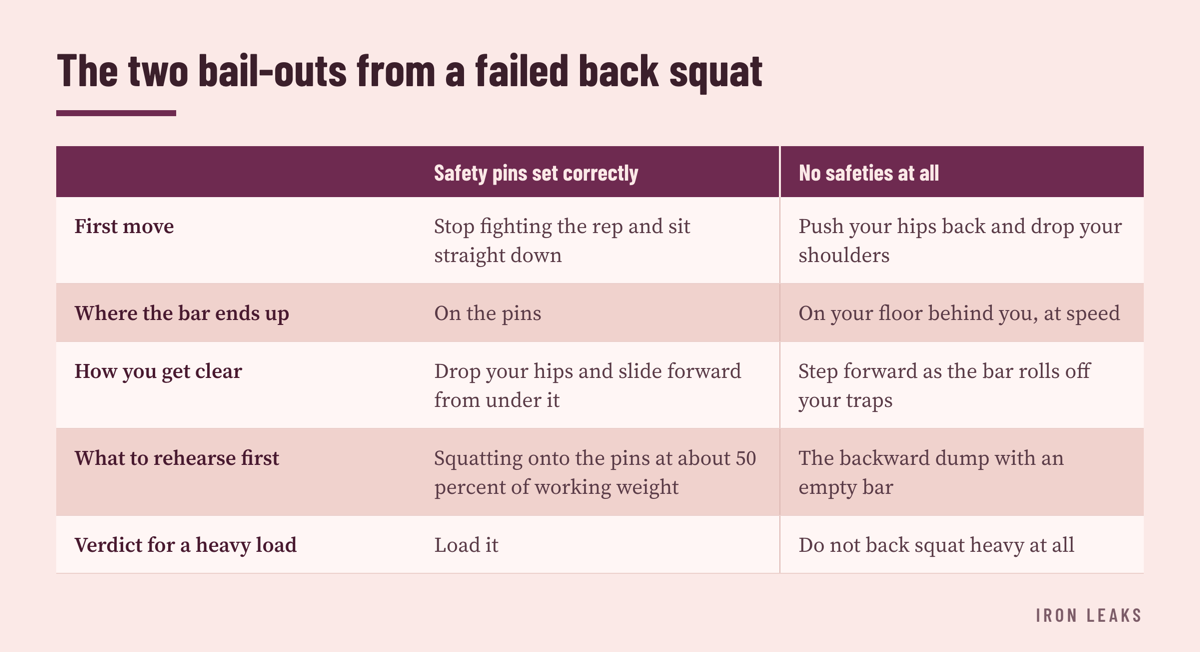
There are two, and which one applies depends entirely on whether you have safeties.
With pins set correctly: stop fighting the rep, sit straight down, let the bar contact the pins, then drop your hips and slide forward out from under it. Do not try to twist. Do not try to save it with your back.
With no safeties at all: the only exit on a back squat is to push your hips back, drop your shoulders, and let the bar roll off your traps behind you while you step forward. It works. It also puts a loaded bar onto your floor at speed, which is a separate problem covered in lifting at home without annoying the neighbors downstairs.
Rehearse the backward dump with an empty bar before you ever need it. A bail-out you have never practiced is not a plan.
Which setups actually catch the bar?
The table separates the setups by what fails and by what physically stops the bar. Read the last column as the thing you must rehearse before loading the bar, not as a suggestion.
| Setup | Most likely failure | What catches the bar | Bail-out to rehearse |
|---|---|---|---|
| Power rack, pins set low | Stall in the hole on the last rep | The pins, every time | Sit down, release, slide forward |
| Power rack, pins set too high | Bar hits pins mid-rep and unloads unevenly | The pins, but at the wrong moment | Lower the pins one hole and retest |
| Squat stands, no safeties | Stall in the hole | Nothing | Backward roll-off, or do not squat heavy |
| Barbell back squat, no rack | Failure to stand, or failure to re-rack | Nothing | Backward roll-off onto matting |
| Front squat or Zercher, no rack | Elbows drop, torso folds | The floor in front of you | Open the arms, let the bar drop forward |
| Dumbbell split squat | Working leg gives out | Your rear foot and the floor | Release both dumbbells to the sides |
| Trap bar, no rack | Failure to complete the pull | The floor, under control | Lower it. There is no trapped position. |
What are the safer heavy substitutes when there is no rack?
Pick lifts you can abandon in any position. That is the single filter, and it eliminates the back squat immediately. It also lines up with where injuries actually land: the review by Aasa and colleagues found the spine, shoulder and knee were the most common injury sites in both powerlifting and weightlifting.
- Front squat or Zercher squat. Both dump forward. Open the elbows and the bar lands in front of you rather than on you.
- Trap bar deadlift. There is no position where you are trapped under load. You either finish the pull or you set it down.
- Rear-foot-elevated split squat. Roughly doubles the relative demand per leg with the same dumbbells, and the exit is to let go with both hands.
You give up top-end load and you keep the training stimulus. A meta-analysis of 21 trials found hypertrophy was similar across light and heavy loads, with maximal strength favoring heavy. If your goal is size rather than a competition total, that is a trade worth making, and the case for it is in building muscle with only adjustable dumbbells.
How close to failure should you train when you lift alone?
Two to three reps in reserve on any barbell squat, and zero to one only on a rep you have already proved the pins will catch. That is the whole autoregulation rule and it costs you almost nothing, because the strongest volume evidence rewards adding weekly sets rather than grinding individual ones.
Refalo and colleagues, in a meta-analysis in Sports Medicine, found no evidence that training to momentary muscular failure beats non-failure training for hypertrophy, with only a trivial advantage for set failure overall. The reps you leave in the tank when you are alone are not lost growth.
Reps in reserve is a scale you can actually use. Zourdos and colleagues validated a repetitions-in-reserve rating against average bar velocity and found a strong inverse relationship in both experienced and novice squatters. If the bar slows visibly on a rep, you are near the top of the scale, and that is the set to end.
Why do people still insist on a spotter?
Because spotters do help, on a different lift. On the bench press the bar can pin you against your own ribcage, and there is no bail-out that does not involve rolling a loaded bar down your torso. A squat has an exit. A bench without safeties does not.
There is also a measurement effect. In a deceptive study of one-rep-max bench testing, measured maximums for male lifters were significantly higher than their own estimates when a spotter was present. Confidence with a person standing there is real. It is not the same thing as safety.
Here is the judgement call, and it is mine. A lifter alone with correctly set pins is safer on a heavy squat than a lifter with an untrained friend and no pins, because the friend will reach for the bar too late and from the wrong angle.
What should you build into every solo session?
Four habits, and none of them cost training time.
- Set and physically test the pins before the first working set, every session, at the depth you will actually use.
- Use collars. An unloaded end tips the bar, a tipped bar defeats the pins, and 90.4 percent of emergency department weight-training injuries involved free weights.
- Keep a phone in the room, not in another room.
- Log reps in reserve alongside load, so the last set is a decision instead of a feeling.
The rest of the progression, once the setup is safe, belongs to progressive overload without more weight, and the sourcing standard behind everything above is in how we research.
Questions readers actually ask
Is it safe to squat heavy without a spotter?
It is safe with correctly set safety pins, which physically stop the bar at a height you have tested. It is not safe on squat stands or with no rack, because nothing catches the bar if you stall at the bottom.
How high should safety pins be set for squats?
One inch, or one pin hole, below the lowest point the bar reaches in your deepest working rep. Find that point with an empty bar, then deliberately squat onto the pins at about half your working weight to confirm.
How do you bail out of a failed squat?
With pins, sit straight down, let the bar rest on them, drop your hips and slide forward. Without safeties, push the hips back, drop the shoulders and let the bar roll off behind you while stepping forward.
Can a spotter actually save a failed squat?
Not reliably. Rescuing a stalled back squat means deadlifting the loaded bar and stabilizing the lifter at once, from behind and with poor leverage. Safety pins remove the bar's path to the floor entirely.
How close to failure should you squat when training alone?
Two to three reps in reserve on barbell squats. A meta-analysis found no evidence that training to momentary failure beats non-failure training for hypertrophy, so the reps you leave are not lost growth.
Sources
- Aasa et al., British Journal of Sports Medicine 2017. Systematic review of injuries in weightlifting and powerlifting; 1.0 to 4.4 injuries per 1,000 training hours in powerlifting.
- Kerr, Collins & Comstock, American Journal of Sports Medicine 2010. US emergency department weight-training injuries; 65.5 percent involved weights dropping on the person.
- Refalo et al., Sports Medicine 2023. No hypertrophy advantage for training to momentary muscular failure over non-failure training.
- Zourdos et al., Journal of Strength and Conditioning Research 2016. Validation of a repetitions-in-reserve based RPE scale against squat bar velocity.
- Schoenfeld, Grgic, Ogborn & Krieger, JSCR 2017. Meta-analysis of 21 trials: similar hypertrophy across loads, maximal strength favored heavy loads.
- Schoenfeld, Ogborn & Krieger, Journal of Sports Sciences 2017. Graded dose-response between weekly sets and muscle hypertrophy.
- Nickerson et al., Journal of Strength and Conditioning Research 2021. Deceptive bench press study; measured maximums exceeded self-estimates with a spotter present.
Links last checked September 7, 2026.
Every figure above is traced to a named source and re-checked on a monthly cycle. Read how we research.
Independence note. Iron Leaks takes no money from supplement brands, equipment makers or gym chains, and carries no affiliate links. Nothing here is medical advice.
Cole Brennan
Cole Brennan has trained in home gyms since 2013 and has coached lifters through the exact constraints this site is about: one pair of adjustable dumbbells, a low ceiling, a downstairs neighbour, and nobody to spot. He built Iron Leaks after watching the biggest fitness sites answer every question except the one a reader with limited equipment and limited time actually asked. He reads the primary literature rather than other people's summaries of it, and every number he publishes carries a link to where it came from. He is not a doctor and does not pretend to be one.
Keep reading
What To Do When Your Dumbbells Are Too Light To Build Muscle
Capped dumbbell load is not the limiter most lifters think. The set counts, rep ranges and exercise swaps that keep light weights…
How To Squat Without a Squat Rack at Home
No rack means front-loaded and single-leg squatting. What each variation loads, what it gives up, and the point where a rack is…
Can You Build Muscle With Only Adjustable Dumbbells?
Dumbbells build muscle for years, but the load cap binds on specific lifts. A table of where a 50 lb and 90…