Home and Minimal Equipment/ September 7, 2026/ 5 min read
What To Do When Your Dumbbells Are Too Light To Build Muscle

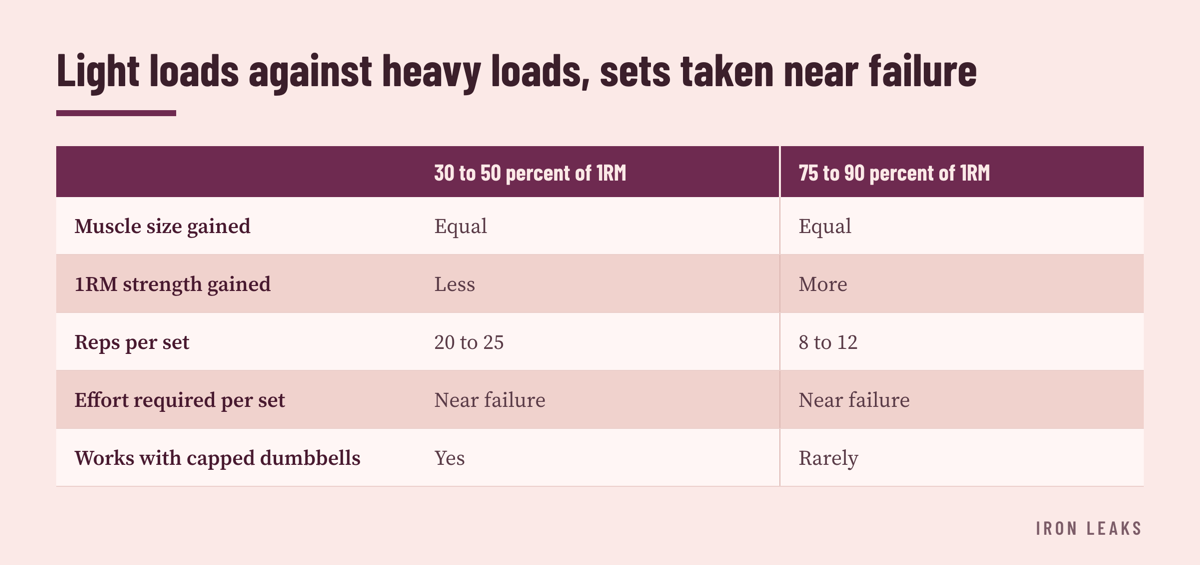
Light dumbbells still build muscle, as long as the sets get hard. Schoenfeld’s 2017 meta-analysis of 21 trials found equal muscle growth above and below 60 percent of one-rep max when sets went to failure. Morton and colleagues grew trained men on 30 to 50 percent for 20 to 25 reps. Below roughly 30 percent, growth drops off.
The load ceiling is not the problem most lifters think it is. In the 2017 systematic review published in the Journal of Strength and Conditioning Research, Brad Schoenfeld and colleagues pooled 21 trials comparing loads at or below 60 percent of one-repetition maximum against loads above 60 percent, with every set taken to momentary muscular failure. Changes in muscle size were similar between the two. Gains in 1RM strength were not: heavy loads won there. So the honest split is that capped dumbbells cost you maximal strength, not size.
Can dumbbells that feel too light still build muscle?
Yes, and the strongest single trial on this is not ambiguous. Morton and colleagues at McMaster University put 49 resistance-trained men through 12 weeks of whole-body training. One group used 30 to 50 percent of 1RM for 20 to 25 reps per set. The other used 75 to 90 percent for 8 to 12 reps. Every set in both groups went to volitional failure.
Lean body mass increased in both. Type I and type II fiber cross-sectional area increased in both. There was no significant difference between the groups on either measure. The only outcome that separated them was bench press 1RM, which favored the heavy group by about 5 kg.
These were experienced lifters, not beginners, which matters because the usual objection is that light loads only work on the untrained. That objection does not survive this study.
How light is too light to build muscle?
There is a floor, and it sits somewhere near 30 percent of your one-rep max. Lasevicius and colleagues at the University of Sao Paulo trained 30 men for 12 weeks using a within-subject design, so each man’s limbs trained at different loads with volume matched. At 12 weeks, vastus lateralis cross-sectional area rose 8.9 percent at 20 percent of 1RM, against 20.5 percent at 40 percent, 20.4 percent at 60 percent and 19.5 percent at 80 percent.
Read that row again. Everything from 40 percent upward landed in the same place. Only the 20 percent condition fell off, and it fell off by more than half.
In practice that means a 20 pound dumbbell is productive for a lifter whose curl max is around 50 pounds and close to useless for someone whose max is 100. The number on the dumbbell tells you nothing on its own. The ratio does.
What set and rep scheme should you use with light dumbbells?
Pick the rep range that puts you within a couple of reps of failure, then hold the rep target and add sets. That is the whole prescription. Refalo and colleagues at Deakin University meta-analyzed 15 studies on proximity to failure and found only a trivial advantage for training to failure over stopping short, with an effect size of 0.19. You need the last few reps to be genuinely hard. You do not need to grind to a standstill on every set.
| How the load feels | Reps per set | Sets per exercise | Where to stop |
|---|---|---|---|
| Hard at 6 to 10 reps | 6 to 10 | 3 to 4 | 1 to 2 reps in reserve |
| Hard at 12 to 20 reps | 12 to 20 | 3 to 4 | 1 to 2 reps in reserve |
| Hard at 20 to 30 reps | 20 to 30 | 4 to 5 | 0 to 1 reps in reserve |
| Easy past 30 reps | Change the exercise | Not applicable | Not applicable |
The last row is the one people skip. Past about 30 reps a set stops being a hypertrophy set and starts being cardio with a dumbbell in your hand.
How many sets per muscle per week do you need?
Volume is where a capped dumbbell setup makes up ground, and the relationship is graded rather than all-or-nothing. Schoenfeld, Ogborn and Krieger’s 2017 meta-analysis in the Journal of Sports Sciences reports a dose-response: each additional weekly set was associated with a 0.37 percent gain in muscle size, and higher volume within a study beat lower volume by 3.9 percent.
Split that volume across the week rather than dumping it into one session. The same group’s 2016 meta-analysis in Sports Medicine found that training a muscle twice a week beat once a week with weekly volume equated, at an effect size of 0.49 against 0.30.
A workable target for a light-dumbbell lifter is 12 to 20 hard sets per muscle group per week, split over two or three sessions. That is more sets than a barbell lifter needs, and it is the price of the load ceiling.
What do you change when even 25 reps is easy?
Change the exercise before you change the weight. A dumbbell that is trivial for a two-leg squat is not trivial for a Bulgarian split squat, because one leg is now carrying the whole load plus your body. That single switch can double the effective load without buying anything, and the other squat variations you can load without a rack work on the same principle.
The moves in order of how much they buy you:
- Go unilateral. Split squats, single-leg hip thrusts, single-arm rows. The largest jump available.
- Extend the range. Deficit split squats off a book, deep pushups on the dumbbell handles.
- Slow the lowering phase. Three seconds down, no pause at the top.
- Cut rest to 60 seconds and hold the rep target across all sets.
- Add sets. The blunt instrument, and the one with the clearest evidence behind it.
Do these in order. Tempo work and short rest get reached for first because they feel dramatic, but they are the smallest levers on the list. The same logic drives the wider approach on our progressive overload without more weight guide, and it applies just as directly whether you own only adjustable dumbbells or a fixed pair.
Judgement call
If you own one fixed pair and can afford one purchase, buy a second heavier pair rather than bands, a bench or a rack. Load range is the constraint you actually have. Everything else on that list solves a problem you do not have yet.
When is it time to buy heavier dumbbells?
Two signals, and you need both before spending money. The first is that your working sets have drifted past 30 reps on your main lower-body movement even in its hardest single-limb version. The second is that you have held 15 or more weekly sets for that muscle for a month and the reps are still climbing without effort.
Until both are true, the equipment is not the limiter. Effort and weekly set count are, and both are free.
A dumbbell is too light only when the hardest version of the movement it can load still leaves you fresh.
One practical note on cost. Adjustable handles with add-on plates cost far less per pound than sealed adjustable sets, and a pair of 25 pound plates extends every movement you already own. If the plan is to add load rather than replace a set, plates are the cheaper path. Our full sourcing and verification method is set out on the how we research page, and the plateau-specific version of this problem is covered in breaking a plateau with limited home gym equipment.
Questions readers actually ask
Can light dumbbells build muscle?
Yes. Schoenfeld's 2017 meta-analysis of 21 trials found muscle growth was similar between loads above and below 60 percent of one-rep max when sets were taken to failure. Maximal strength gains still favored heavy loads.
How many reps should you do with light dumbbells?
Use 20 to 30 reps per set and stop within one rep of failure. Morton and colleagues grew resistance-trained men over 12 weeks using 30 to 50 percent of one-rep max for 20 to 25 reps per set.
How light is too light to build muscle?
Around 20 percent of your one-rep max. Lasevicius and colleagues found vastus lateralis growth of 8.9 percent at 20 percent of 1RM against roughly 20 percent at 40, 60 and 80 percent over 12 weeks.
How many sets per week do you need with light dumbbells?
Aim for 12 to 20 hard sets per muscle group per week, split across two or three sessions. Each extra weekly set is associated with a 0.37 percent gain in muscle size in Schoenfeld's dose-response meta-analysis.
What should you change before buying heavier dumbbells?
Switch to single-limb versions first, then extend the range of motion, then slow the lowering phase, then cut rest, then add sets. Single-limb work is the largest jump in effective load and costs nothing.
Sources
- Schoenfeld BJ, Grgic J, Ogborn D, Krieger JW. Strength and hypertrophy adaptations between low- vs. high-load resistance training. J Strength Cond Res 2017;31(12):3508-3523. Meta-analysis of 21 trials: similar hypertrophy across loading ranges, greater 1RM strength with heavy loads.
- Morton RW et al. Neither load nor systemic hormones determine resistance training-mediated hypertrophy or strength gains. J Appl Physiol 2016;121(1):129-138. Twelve weeks in 49 trained men; 30 to 50 percent of 1RM matched 75 to 90 percent for lean mass and fiber area.
- Lasevicius T et al. Effects of different intensities of resistance training with equated volume load. Eur J Sport Sci 2018;18(6):772-780. Twenty percent of 1RM was suboptimal for cross-sectional area; 40 percent and above were equivalent.
- Refalo MC et al. Influence of resistance training proximity-to-failure on skeletal muscle hypertrophy. Sports Med 2023;53(3):649-665. Fifteen studies; only a trivial advantage for training to failure over stopping short.
- Schoenfeld BJ, Ogborn D, Krieger JW. Dose-response relationship between weekly resistance training volume and muscle hypertrophy. J Sports Sci 2017;35(11):1073-1082. Graded dose-response: 0.37 percent additional gain per weekly set.
- Schoenfeld BJ, Ogborn D, Krieger JW. Effects of resistance training frequency on measures of muscle hypertrophy. Sports Med 2016;46(11):1689-1697. Twice-weekly training beat once-weekly with volume equated.
Links last checked September 7, 2026.
Every figure above is traced to a named source and re-checked on a monthly cycle. Read how we research.
Independence note. Iron Leaks takes no money from supplement brands, equipment makers or gym chains, and carries no affiliate links. Nothing here is medical advice.
Cole Brennan
Cole Brennan has trained in home gyms since 2013 and has coached lifters through the exact constraints this site is about: one pair of adjustable dumbbells, a low ceiling, a downstairs neighbour, and nobody to spot. He built Iron Leaks after watching the biggest fitness sites answer every question except the one a reader with limited equipment and limited time actually asked. He reads the primary literature rather than other people's summaries of it, and every number he publishes carries a link to where it came from. He is not a doctor and does not pretend to be one.
Keep reading
How To Squat Without a Squat Rack at Home
No rack means front-loaded and single-leg squatting. What each variation loads, what it gives up, and the point where a rack is…
Can You Build Muscle With Only Adjustable Dumbbells?
Dumbbells build muscle for years, but the load cap binds on specific lifts. A table of where a 50 lb and 90…