You do not squat without a rack. You change the lift. Front-loaded and single-leg variations put the load somewhere you can lift it to unaided: goblet squats, front-rack dumbbell squats, Bulgarian split squats, step-ups and hip thrusts off a bench. Gullett’s biomechanics work found the front squat matched the back squat for muscle recruitment at lower spinal and knee cost.
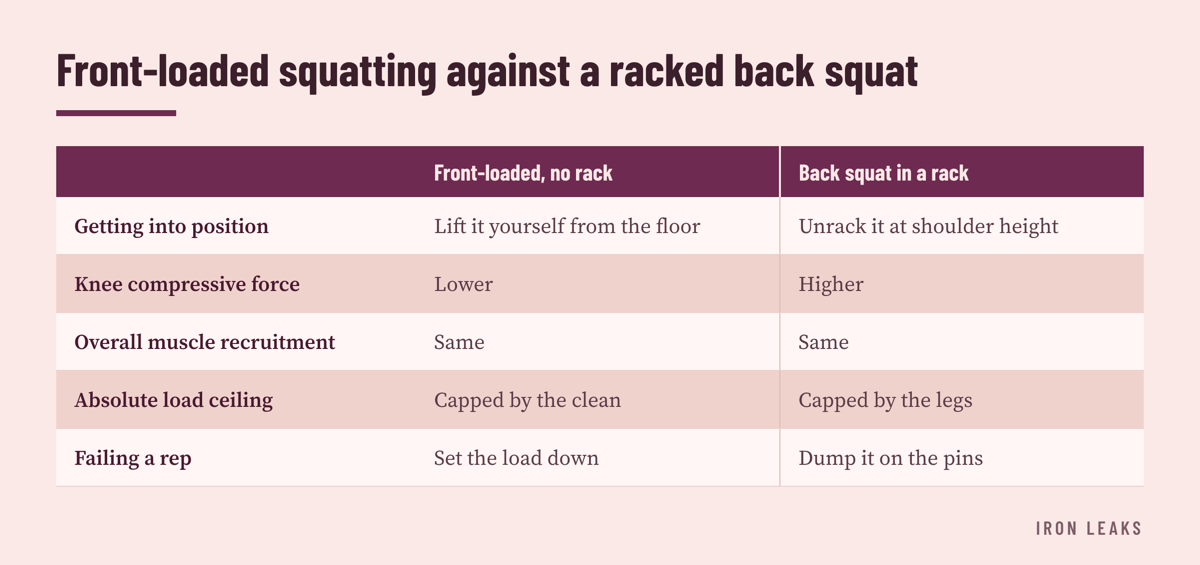
The rack solves exactly one problem: it holds a bar above waist height so you can get under it, and it catches the bar when you fail. Every rack-free squat variation is a workaround for the first job and an avoidance of the second. Gullett and colleagues at the University of Florida measured 15 trained lifters doing front and back squats and found the back squat produced significantly higher knee compressive forces and extensor moments, while overall muscle recruitment was the same. The front-loaded position is not a downgrade. It is a different trade.
Can you build legs without a squat rack?
Yes, and the load ceiling is less of a problem than it looks. Schoenfeld’s 2017 meta-analysis of 21 trials in the Journal of Strength and Conditioning Research found muscle growth was similar whether training used loads above or below 60 percent of one-rep max, provided every set went to failure. What heavy loads clearly won was 1RM strength.
So the thing a rack buys you is a bigger number in a maximal strength test. It does not buy you a monopoly on muscle. That distinction is the whole article.
Contreras and colleagues, publishing in the Journal of Applied Biomechanics, compared gluteus maximus, biceps femoris and vastus lateralis activity across front, full and parallel squats in trained women and found no statistical differences between the three. Their conclusion was direct: despite requiring lighter loads, the front squat may provide a similar training stimulus to the back squat.
Which squat variations can you load without a rack?
The test for any rack-free variation is simple. Can you get the load into position by yourself, from the floor, without anything holding it at shoulder height? That question eliminates the barbell back squat above roughly your clean and press, and it leaves five workable options.
| Variation | Getting the load into position | Practical load ceiling | What it gives up |
|---|---|---|---|
| Goblet squat | Curl one dumbbell to the chest | What you can curl and cradle | Lowest ceiling of the five |
| Front-rack dumbbell squat | Clean two dumbbells to the shoulders | Roughly double the goblet | Wrist and shoulder position |
| Bulgarian split squat | Hold a dumbbell in each hand | Grip fails before the legs do | Balance limits the last reps |
| Step-up | Hold a dumbbell in each hand | Grip and step height | Little stretch under load |
| Hip thrust off a bench | Roll the bar or set a dumbbell in the crease | Highest of the five | Almost no quad involvement |
Two of those rows deserve a note. The Bulgarian split squat is limited by your hands, not your legs, which is why it eventually needs straps or a vest. The hip thrust loads more than anything else on the list, and that is why it belongs in the plan even though it trains almost nothing at the knee. Every row on that list runs on dumbbells, and whether adjustable dumbbells alone are enough to build muscle covers the rest of the body on the same equipment.
How much does the front-loaded position actually cost you?
Less than the gym-floor consensus assumes, and the loss is specific. Gullett’s group found the front squat was as effective as the back squat for overall muscle recruitment while producing significantly lower compressive forces at the knee. The front-loaded position also self-limits: when the bar or the dumbbells start to slide forward, the set ends, which is precisely the safety feature you want with no spotter and no pins.
What it costs is absolute load. You can back squat more than you can front squat, and you can front squat more than you can goblet squat. That is a strength-testing problem rather than a muscle problem, and it only becomes a real limitation when your goal is a competition total.
There is a second cost that nobody mentions. Front-loaded squats end when your upper back gives out, not when your legs do, so the last two reps of a hard set are often a posture failure rather than a quad failure. The fix is not more weight. It is more sets at a load your trunk can hold, which is exactly the direction the volume evidence points anyway.
If your training is running without a spotter as well as without a rack, the safety logic is worked through in full in squatting heavy at home without a spotter.
Is the hip thrust a substitute for the squat?
It is a supplement, not a replacement, and there is a trial that says so. Contreras and colleagues randomized adolescent male athletes to six weeks of either front squats or barbell hip thrusts and published the result in the Journal of Strength and Conditioning Research. The front squat group showed potentially beneficial effects for front squat strength and vertical jump height. The hip thrust group showed potentially beneficial effects for 10 and 20 meter sprint times and was very likely superior for isometric midthigh pull strength.
Different force vectors, different results. Neither exercise covered the other’s ground.
Run both. The hip thrust is where the heavy load goes because it is the easiest lift on the list to load without a rack, and the front-loaded squat is where the knee-extension work goes.
Judgement call
Do not spend money on a half rack before you have run Bulgarian split squats to a genuine grip limit for three months. Most home lifters buy a rack to solve a load ceiling they have never actually reached on one leg. A pair of straps costs less than one percent of a rack and removes the same constraint.
How do you make a light squat hard enough?
Add sets and add sessions before you add anything else. Schoenfeld, Ogborn and Krieger’s dose-response meta-analysis in the Journal of Sports Sciences reports a graded relationship between weekly set volume and muscle size, at roughly 0.37 percent additional gain per weekly set, with higher-volume conditions beating lower-volume conditions by 3.9 percent.
Split those sets across the week. The same authors’ 2016 review in Sports Medicine found twice-weekly training beat once-weekly with volume equated, at an effect size of 0.49 against 0.30.
The practical version for a rack-free lifter: 14 to 20 hard sets for the legs per week, spread over two or three days, with sets ending within one or two reps of failure. Progress by adding reps to a fixed load until the top of the range, then adding a set, then moving to a harder variation. That ladder is the same one used in progressive overload without more weight.
When do you actually need a rack?
When you are training for a one-rep max in the back squat, and not before. A rack is a strength-testing tool and a bailout device. If your goal is muscle, the evidence above says a spectrum of loads gets you there, so the rack is a convenience.
Three signals say buy one. You have hit the grip ceiling on split squats even with straps. You are running 20 weekly leg sets and still recovering easily. And you want a tested squat number rather than a bigger pair of legs. Two out of three is not enough.
A rack does not build the muscle. It holds the bar while you get under it.
How we weigh trials, position stands and mechanical reasoning against each other is set out on the how we research page. If your ceiling is dumbbell weight rather than the rack itself, the parallel problem is covered in what to do when your dumbbells are too light.
Questions readers actually ask
Can you build legs without a squat rack?
Yes. Schoenfeld's meta-analysis of 21 trials found similar muscle growth across a wide spectrum of loads when sets went to failure. A rack mainly buys a higher one-rep max, not more muscle.
What is the best squat variation without a rack?
The front-rack dumbbell squat loads roughly twice what a goblet squat does and still gets into position from the floor. Bulgarian split squats load more per leg but hit a grip ceiling before a leg ceiling.
Is the front squat as good as the back squat?
For muscle recruitment, yes. Gullett and colleagues found the front squat matched the back squat for overall recruitment while producing significantly lower knee compressive forces and extensor moments in 15 trained lifters.
Can hip thrusts replace squats?
No. In a six-week randomized trial, front squats favored vertical jump and squat strength while hip thrusts favored 10 and 20 meter sprint times and midthigh pull strength. The two exercises did not substitute for each other.
How many leg sets per week without a rack?
Fourteen to twenty hard sets per week, split across two or three sessions. Weekly set volume shows a graded dose-response with muscle size, and twice-weekly training beats once-weekly at equated volume.
Sources
- Gullett JC, Tillman MD, Gutierrez GM, Chow JW. A biomechanical comparison of back and front squats in healthy trained individuals. J Strength Cond Res 2009;23(1):284-292. Front squat matched the back squat for muscle recruitment with lower knee compressive forces and extensor moments.
- Contreras B et al. A comparison of gluteus maximus, biceps femoris and vastus lateralis EMG amplitude in the parallel, full and front squat. J Appl Biomech 2016;32(1):16-22. No statistical differences between front, full and parallel squats in any muscle tested.
- Contreras B et al. Effects of a six-week hip thrust vs. front squat resistance training program on performance in adolescent males. J Strength Cond Res 2017;31(4):999-1008. Randomized trial; front squat favored jump and squat strength, hip thrust favored sprint times and midthigh pull.
- Schoenfeld BJ, Grgic J, Ogborn D, Krieger JW. Strength and hypertrophy adaptations between low- vs. high-load resistance training. J Strength Cond Res 2017;31(12):3508-3523. Twenty-one trials; hypertrophy similar across loading ranges, maximal strength favored heavy loads.
- Schoenfeld BJ, Ogborn D, Krieger JW. Dose-response relationship between weekly resistance training volume and muscle hypertrophy. J Sports Sci 2017;35(11):1073-1082. Each additional weekly set associated with a 0.37 percent gain in muscle size.
- Schoenfeld BJ, Ogborn D, Krieger JW. Effects of resistance training frequency on measures of muscle hypertrophy. Sports Med 2016;46(11):1689-1697. Twice-weekly training per muscle beat once-weekly at equated volume.
Links last checked September 7, 2026.
Every figure above is traced to a named source and re-checked on a monthly cycle. Read how we research.
Independence note. Iron Leaks takes no money from supplement brands, equipment makers or gym chains, and carries no affiliate links. Nothing here is medical advice.

Cole Brennan
Cole Brennan has trained in home gyms since 2013 and has coached lifters through the exact constraints this site is about: one pair of adjustable dumbbells, a low ceiling, a downstairs neighbour, and nobody to spot. He built Iron Leaks after watching the biggest fitness sites answer every question except the one a reader with limited equipment and limited time actually asked. He reads the primary literature rather than other people's summaries of it, and every number he publishes carries a link to where it came from. He is not a doctor and does not pretend to be one.
Keep reading
What To Do When Your Dumbbells Are Too Light To Build Muscle
Capped dumbbell load is not the limiter most lifters think. The set counts, rep ranges and exercise swaps that keep light weights…
Can You Build Muscle With Only Adjustable Dumbbells?
Dumbbells build muscle for years, but the load cap binds on specific lifts. A table of where a 50 lb and 90…