Home and Minimal Equipment/ September 7, 2026/ 6 min read
Can You Build Muscle With Only Adjustable Dumbbells?

Yes, and further than most people assume. Muscle growth tracks effort and weekly sets more than the number on the handle, so a pair of adjustable dumbbells builds size for years. The limit is not muscle, it is the load cap meeting a specific lift. Legs and back hit that wall long before arms, shoulders and chest do.
Morton and colleagues at McMaster University trained 49 resistance-trained men for 12 weeks, one group at 30 to 50 percent of maximum for 20 to 25 reps per set and one at 75 to 90 percent for 8 to 12. Lean mass and type I and type II fiber cross-sectional area rose the same in both groups. Only bench press strength separated them, by 14 kg against 9 kg. Load did not dictate hypertrophy.
Can you build muscle with only adjustable dumbbells?
You can, because the two variables with the strongest evidence behind muscle growth are both available to you. Weekly sets and proximity to failure do not require a barbell.
Schoenfeld’s volume meta-analysis in the Journal of Sports Sciences found a graded dose-response, with each additional weekly set worth about 0.37 percent more growth. A separate meta-analysis pooling 21 trials on load reported that hypertrophy was similar between light and heavy loads while maximal strength favored heavy.
Read those two together and the picture is clear. Adjustable dumbbells are a complete tool for building muscle and an incomplete tool for building maximal strength. That distinction is the entire answer, and it is the one equipment blogs skip.
Where does a 50 lb or 90 lb per-hand cap stop being enough?
It depends on the lift, not on the lifter’s ambition. A pair of dumbbells gives you two separate ceilings: the per-hand cap on anything held in one hand, and double that on anything held in two.
The table below assumes a 180 lb lifter and a two-dumbbell set. The thresholds in the final column are the editor’s estimates from the loads these lifts typically require, not findings from a study. Treat them as a planning guide, and treat your own log as the real evidence.
| Lift | Load at 50 lb per hand | Load at 90 lb per hand | Where it runs out |
|---|---|---|---|
| Goblet squat | 50 lb, one bell | 90 lb, one bell | Almost immediately. It is a movement primer, not a leg builder, past the first few months. |
| Two-dumbbell squat | 100 lb | 180 lb | Within a year for most people. Grip and torso position fail before the legs do. |
| Bulgarian split squat | 100 lb on one leg | 180 lb on one leg | Years. This is the lift that keeps dumbbells relevant for legs. |
| Romanian deadlift | 100 lb | 180 lb | Early. Trained hips move well over bodyweight here, so go single-leg or add tempo. |
| Flat dumbbell press | 100 lb | 180 lb | Roughly around an intermediate barbell bench. Late for most home lifters. |
| One-arm row | 50 lb | 90 lb | Mid to late. Straps and a slow lowering phase extend it well past the grip limit. |
| Overhead press | 100 lb | 180 lb | Rarely. Standing pressing strength caps below this for the large majority of lifters. |
| Curl, lateral raise, triceps | 50 lb per hand | 90 lb per hand | Effectively never. No arm or side delt outgrows 90 lb in one hand. |
Which muscle groups cap out first?
Legs, then hips, then back. Then, a long way behind, chest. Arms and shoulders never get there.
The reason is simple mechanics. The quadriceps and hip extensors are the largest and strongest muscle groups you own, and a bilateral leg movement asks them to share a load that two hands have to carry. A 180 lb total is a warm-up set for a squat and a serious set for a lateral raise.
Pulling is the second problem, and it is a grip problem before it is a back problem. Your lats will keep accepting load after your fingers stop holding it, which is why the row column above says late rather than never.
What do you do when your legs outgrow the dumbbells?
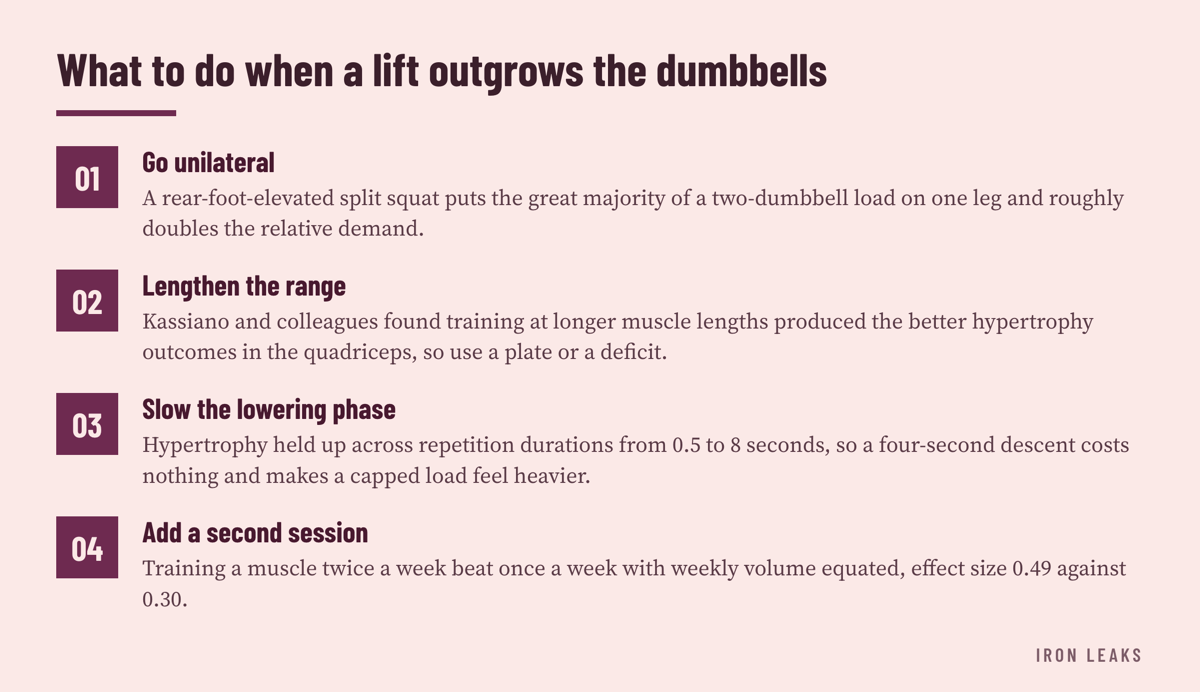
Go unilateral before you go shopping. A rear-foot-elevated split squat places the great majority of a two-dumbbell load on one leg, which roughly doubles the relative demand without adding an ounce of iron. It is one of five squat variations you can load from the floor without a rack.
Then lengthen the range. The systematic review by Kassiano and colleagues concluded that training at longer muscle lengths produced the better hypertrophy outcomes in the quadriceps, so a front foot on a plate or a deficit under the working leg is a real progression, not a gimmick.
Then slow it down. Hypertrophy held up across repetition durations from 0.5 to 8 seconds, which means a four-second lowering phase costs you nothing in growth and makes a capped load feel considerably heavier. The full sequence for all of this is set out in the guide to progressive overload without more weight.
What can adjustable dumbbells never give you?
Three things, and it is worth being blunt about them.
- A true maximal strength stimulus for the lower body. The load meta-analysis found one-rep-max strength gains significantly favored heavy loads. If a heavy squat or deadlift number is your goal, dumbbells are the wrong tool.
- A stable spinal load. Nothing in a dumbbell rack loads the trunk the way a bar on your back does, and no split squat variation substitutes for it.
- A grip-free heavy pull. Every dumbbell pull is capped by your hands. A barbell or trap bar with straps is not.
If any of those matter to you, the honest answer is a rack and a bar, not another dumbbell. Working out alone changes how you approach that, and how to squat heavy without a spotter covers the setup before you buy anything.
How long before the cap actually matters?
Longer than the equipment sites imply, because the cap only binds when every other lever is spent. In practice that means you have already added sets, added a second weekly session per muscle, gone unilateral on legs, and slowed your tempo. If the set you own is fixed rather than adjustable and already feels light, what to do when the dumbbells are too light runs those levers in order.
Frequency alone buys a lot of that time for free. Schoenfeld’s frequency meta-analysis found that training a muscle twice a week beat once a week with weekly volume equated, effect size 0.49 against 0.30. That is a progression you make by moving sets to another day.
Here is the judgement call. For a lifter whose goal is muscle rather than a competition total, a 90 lb per-hand adjustable set plus a bench is enough equipment for three to five years of honest progress, and the people who plateau in year one plateaued on effort, not on iron. Realistic timelines for what that adds up to are in how much muscle you can actually build naturally.
Does training closer to failure fix the load problem?
Partly, and less than the internet claims. The proximity-to-failure meta-analysis in Sports Medicine found no evidence that training to momentary muscular failure beats non-failure training for hypertrophy, and only a trivial advantage for set failure overall.
What that means in practice: you do not need to grind every light set into the ground. Stopping one to two reps short is enough, and it keeps the following sets usable.
Rest matters more than most home lifters allow. In an eight-week trial with everything else equated, three-minute rest intervals produced more strength and more anterior thigh growth than one-minute intervals. If you have a small apartment and short sessions, that trade is worth knowing about before you cut rest to save time.
Does what you eat change the answer?
It changes the ceiling more than the equipment does. The position stand of the International Society of Sports Nutrition puts daily protein for building and maintaining muscle at 1.4 to 2.0 g per kg of body weight, spread evenly every three to four hours at roughly 0.25 g per kg per meal.
Morton and colleagues, in a separate meta-analysis in the British Journal of Sports Medicine, found that total protein intake beyond 1.62 g per kg per day produced no further training-induced gain in fat-free mass. That number is a ceiling, not a target to beat.
A lifter eating 1.6 g per kg on capped dumbbells will out-gain a lifter eating 0.8 g per kg with a full rack. The practical version of that is in how much to eat as a lifter, and if you want to see how we check numbers like these before publishing them, that is set out in how we research.
Questions readers actually ask
Can you build muscle with only adjustable dumbbells?
Yes. Trained men who lifted at 30 to 50 percent of their maximum for 20 to 25 reps per set gained the same lean mass and fiber size as men lifting at 75 to 90 percent. Weekly sets and effort matter more than load.
What weight of adjustable dumbbells do you need?
A 50 lb per-hand set covers most upper body work for years. A 90 lb per-hand set adds several more years on pressing and rowing. Neither is enough for a heavy bilateral squat or deadlift for a trained lifter.
Which muscles cap out first with dumbbells?
Legs first, then hips, then back. Chest is a long way behind. Arms and shoulders effectively never cap, because no biceps or side deltoid outgrows 90 lb held in one hand.
How do you progress when the dumbbells max out?
Go unilateral, which roughly doubles relative load per limb. Then lengthen the range of motion with an elevation or deficit. Then slow the lowering phase to three or four seconds. Then add weekly sets or a second session.
Are dumbbells enough for strength as well as size?
For size, yes. For maximal strength, no. A meta-analysis of 21 trials found hypertrophy was similar across light and heavy loads, but one-rep-max strength gains significantly favored heavy loads.
Sources
- Morton et al., Journal of Applied Physiology 2016. Trained men gained equal lean mass at 30 to 50 percent and 75 to 90 percent of maximum.
- Schoenfeld, Grgic, Ogborn & Krieger, JSCR 2017. Meta-analysis of 21 trials: hypertrophy similar across loads, maximal strength favored heavy.
- Schoenfeld, Ogborn & Krieger, Journal of Sports Sciences 2017. Graded dose-response between weekly sets and hypertrophy.
- Kassiano et al., JSCR 2023. Systematic review favoring training at longer muscle lengths for hypertrophy.
- Jager et al., ISSN Position Stand, JISSN 2017. Daily protein of 1.4 to 2.0 g per kg for building and maintaining muscle.
- Morton et al., British Journal of Sports Medicine 2018. No further fat-free mass benefit beyond 1.62 g of protein per kg per day.
Links last checked September 7, 2026.
Every figure above is traced to a named source and re-checked on a monthly cycle. Read how we research.
Independence note. Iron Leaks takes no money from supplement brands, equipment makers or gym chains, and carries no affiliate links. Nothing here is medical advice.
Cole Brennan
Cole Brennan has trained in home gyms since 2013 and has coached lifters through the exact constraints this site is about: one pair of adjustable dumbbells, a low ceiling, a downstairs neighbour, and nobody to spot. He built Iron Leaks after watching the biggest fitness sites answer every question except the one a reader with limited equipment and limited time actually asked. He reads the primary literature rather than other people's summaries of it, and every number he publishes carries a link to where it came from. He is not a doctor and does not pretend to be one.
Keep reading
What To Do When Your Dumbbells Are Too Light To Build Muscle
Capped dumbbell load is not the limiter most lifters think. The set counts, rep ranges and exercise swaps that keep light weights…
How To Squat Without a Squat Rack at Home
No rack means front-loaded and single-leg squatting. What each variation loads, what it gives up, and the point where a rack is…