Realistic Progress/ September 7, 2026/ 7 min read
How Much Muscle Can a 40-Year-Old Gain in 6 Months?

Nobody has run a six-month muscle trial on 40-year-olds. The closest measured result is Churchward-Venne’s 24-week analysis in adults over 65: 1.1 kg of lean body mass, with 0.9 kg of it already banked by week 12. Volek’s nine-month beginner trial produced 1.8 to 3.3 kg. Plan on 1 to 3 kg.
Resistance training research runs 8 to 12 weeks. That is the standard length, and it is the reason this question has no clean answer. Churchward-Venne and colleagues, writing in the Journal of the American Medical Directors Association, are one of the very few groups who measured the same people at both 12 and 24 weeks: 110 older adults at the first mark, 85 at the second. Lean body mass rose 0.9 kg over 12 weeks and 1.1 kg over 24. Peterson, Sen and Gordon pooled 49 studies of adults over 50 in Medicine and Science in Sports and Exercise and got 1.1 kg.
Those are the numbers that exist. Everything past them is arithmetic somebody did on a spreadsheet.
How much muscle can a 40-year-old gain in 6 months?
One to three kilograms of lean body mass, which is roughly 2 to 7 lb, if you train hard and eat enough protein for the whole six months. The lower end is what supervised trials in older adults produce. The upper end requires that you are new to lifting, not chronically underfed, and consistent across all 24 weeks.
Two published anchors bracket that. Churchward-Venne’s over-65 cohort added 1.1 kg over 24 supervised weeks. At the other end, Volek and colleagues put 63 untrained men and women through 96 supervised workouts across about nine months, reported in the Journal of the American College of Nutrition, and lean body mass rose 3.3 kg in the whey group, 2.3 kg with carbohydrate and 1.8 kg with soy.
A 40-year-old sits between those populations and neither trial recruited one. That is the honest position. Our pillar on natural rate of gain takes the same line, and it is not a hedge: the number simply has not been measured in this age band over this duration.
What do the six-month studies actually report?
Very few resistance training trials reach 24 weeks at all, and the ones that do were run in older adults or in beginners, not in middle-aged lifters. Here is every long-duration result worth quoting, at the duration the study actually ran, with nothing scaled up.
| Study | Population | Duration | Lean mass change |
|---|---|---|---|
| Churchward-Venne et al., JAMDA 2015 | Men and women over 65 | 12 weeks, then 24 weeks | +0.9 kg, then +1.1 kg |
| Volek et al., J Am Coll Nutr 2013 | 63 untrained men and women | 96 workouts, about 9 months | +1.8 to +3.3 kg by supplement group |
| Peterson et al., Med Sci Sports Exerc 2011 | 1,328 adults aged 50 and over | Mixed durations, 49 studies | +1.1 kg pooled |
| Josse et al., Med Sci Sports Exerc 2010 | 20 untrained young women | 12 weeks, 5 days a week | +1.1 kg control, +1.9 kg milk |
| Blocquiaux et al., Exp Gerontol 2020 | 30 older men, train and detrain and retrain | 12 weeks per block | +29% type II fiber area on retraining |
Note what is missing from that table: a single row of healthy 40-year-olds followed for half a year. That gap is why five of the seven pages currently ranking for this question are calculators with no prose behind them.
Why does the second three months add less than the first?
Because gains decelerate inside the same program. Churchward-Venne’s data is the cleanest demonstration in the literature: 0.9 kg in the first 12 weeks, 1.1 kg by week 24. Doubling the training time added 0.2 kg. Straight-line extrapolation would have predicted 1.8 kg and overshot the real result by 64%.
That decay is the single most important thing to understand about a six-month plan. Your first block is not a rate you can repeat. It is the fastest block you will ever have, and the honest expectation for months four through six is a fraction of what months one through three delivered.
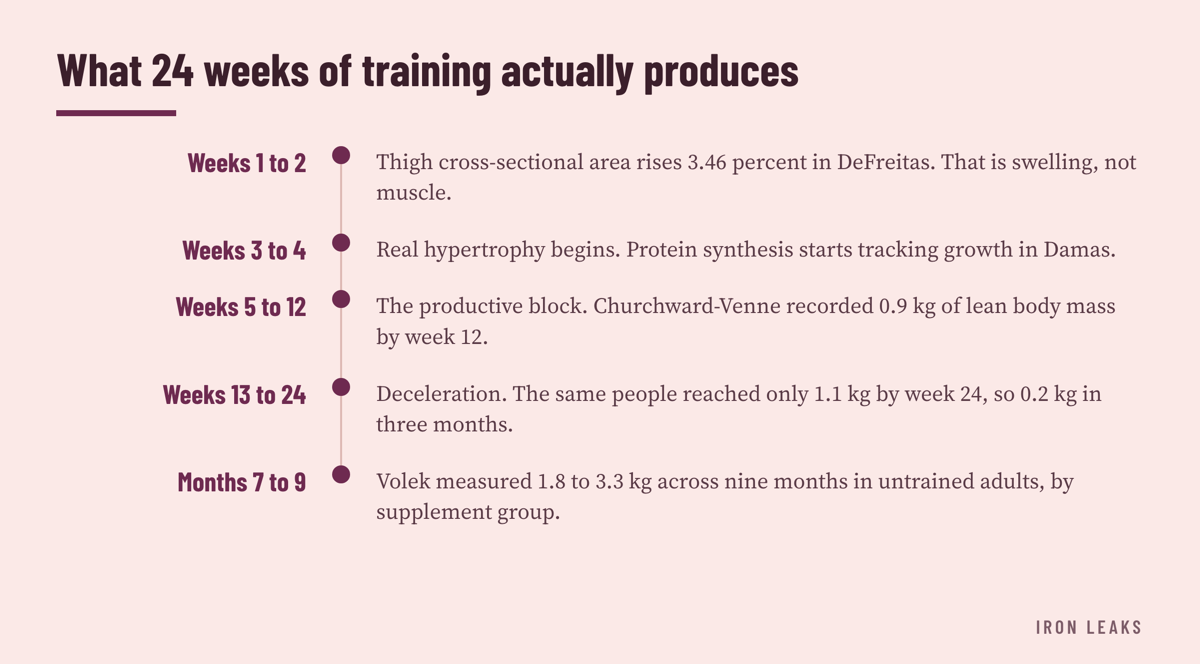
Volek’s team measured body composition at 3, 6 and 9 months for exactly this reason. Damas and colleagues, in the Journal of Physiology, tracked ten men at weeks one, three and ten and found fiber cross-sectional area increased only by the ten-week mark, despite protein synthesis spiking hardest in week one.
Does being 40 change the number?
Slightly, and less than most pages claim. Morton and colleagues pooled 49 randomized trials with 1,863 participants in the British Journal of Sports Medicine and found the fat-free mass benefit of protein supplementation fell by 0.01 kg per year of age, which was statistically significant at p=0.002 but tiny in absolute terms. Peterson’s meta-regression found older participants gained less lean mass, at a coefficient of minus 0.03.
Ahtiainen and colleagues went further. They pooled 287 untrained adults aged 19 to 78 in Age and reported that age and sex did not predict who responded. Mean muscle size change was 4.8%, with a range from minus 11% to plus 30%.
So age shaves the average and does not decide your individual outcome. A 40-year-old who trains twice a week per muscle group will outgain a 25-year-old who trains once. Schoenfeld’s meta-analysis in Sports Medicine puts that frequency effect at an effect size of 0.49 against 0.30 when weekly volume is matched.
How much of the first six months is not muscle?
More than the scale suggests. DeFreitas and colleagues scanned 25 sedentary men weekly in the European Journal of Applied Physiology and measured a 3.46% thigh cross-sectional area increase after just two training sessions. That is swelling, not tissue. They concluded real hypertrophy began somewhere around weeks three and four.
Glycogen and the water stored with it add scale weight in the first fortnight too. So does a fuller gut on a higher-calorie diet. If you weigh 4 lb heavier after three weeks, a good share of that is not new muscle and it will not keep accruing at that rate.
This matters for anyone judging month one and deciding the program works. It also matters at the other end: people who lose fat while training see the scale sit still for weeks while their measurements move. That is covered in how to tell you are progressing without adding weight.
What about the one to two pounds a month rule?
Those tables are coaching heuristics, not findings. The best known versions come from Lyle McDonald and Alan Aragon, and both are practitioner models built to give clients a planning figure. Neither is a study, neither reports a confidence interval, and neither was validated against a trial in 40-year-olds.
A coaching heuristic is a planning tool, not evidence, and it should never be quoted with the authority of a trial. The honest use of them is as a sanity check on your own expectations. The dishonest use, which is most of the internet, is presenting the output of a model as a measured rate of gain.
Judge it this way. The heuristic figures happen to land in roughly the same territory as the published trials over six months, which is why they have survived. That is a reason to treat them as reasonable, not a reason to cite them as data. Our methodology page explains where we draw that line.
What actually decides where you land in the range?
Four things, in order of how much they move the result. Total weekly hard sets per muscle group, protein intake, consistency across all 24 weeks, and training age.
- Volume. Schoenfeld, Ogborn and Krieger found a graded dose-response in the Journal of Sports Sciences: each additional weekly set was worth 0.37% more growth.
- Protein. The ISSN position stand puts the range at 1.4 to 2.0 g per kg of body weight per day, spread every 3 to 4 hours.
- Consistency. Twenty-four weeks means about 72 sessions at three days a week. Missing one week in four turns your six-month program into a four-and-a-half-month program.
- Training age. Morton found supplementation worked better in already resistance-trained people by 0.75 kg, so a returning lifter is not starting from the same place as a true beginner.
If you are new to lifting and over 40, read whether newbie gains still happen after 40 before you set a target. If you want the frequency question settled, the after-40 pillar covers it.
What should you plan around?
Set the target at 2 kg of lean body mass over six months and treat anything above 3 kg as a good outcome rather than the plan. If you intend to lose fat across the same six months, settle whether you can build muscle and lose fat at the same time after 40 before you fix that number. Weigh once a week, take a waist measurement monthly, and log every set. The scale alone will mislead you for the first month.
Judge the six months by the training log, not the mirror. If your working weights and total weekly sets both went up and your protein held at the ISSN range the whole time, you got what was available. If they did not, no amount of recalculating the target will change the outcome.
Questions readers actually ask
How much muscle can a 40-year-old realistically gain in 6 months?
Roughly 1 to 3 kg of lean body mass. Churchward-Venne and colleagues reported 1.1 kg over 24 supervised weeks in adults over 65, and Volek and colleagues reported 1.8 to 3.3 kg over about nine months in untrained adults.
Why do gains slow down after the first three months?
Because the response decelerates within the same program. Churchward-Venne measured 0.9 kg of lean mass at 12 weeks and 1.1 kg at 24 weeks in the same people. Doubling the training time added only 0.2 kg.
Is the one to two pounds of muscle per month rule accurate?
It is a coaching heuristic, not a research finding. The best known versions come from practitioners rather than trials, carry no confidence intervals, and were never validated in 40-year-olds. Treat them as planning tools only.
Does age 40 reduce how much muscle you can build?
Slightly. Morton and colleagues found the fat-free mass benefit fell by 0.01 kg per year of age. Ahtiainen and colleagues pooled 287 adults aged 19 to 78 and found age did not predict who responded well.
How much of early scale weight is actually muscle?
Less than it looks. DeFreitas and colleagues measured a 3.46 percent thigh area increase after two training sessions, which is swelling. They concluded real hypertrophy started around weeks three and four.
Sources
- Churchward-Venne et al., J Am Med Dir Assoc 2015. Lean body mass at 12 and 24 weeks of supervised resistance training in adults over 65
- Volek et al., J Am Coll Nutr 2013. 63 untrained adults, 96 supervised workouts over about nine months, 1.8 to 3.3 kg lean mass
- Peterson, Sen and Gordon, Med Sci Sports Exerc 2011. Meta-analysis of 49 studies, 1,328 adults over 50, pooled lean body mass gain 1.1 kg
- Morton et al., Br J Sports Med 2018. 49 randomized trials, protein and fat-free mass, age and training status effects
- DeFreitas et al., Eur J Appl Physiol 2011. Weekly thigh scans showing early edema and hypertrophy beginning around weeks three to four
- Ahtiainen et al., Age 2016. 287 untrained adults aged 19 to 78, individual response range and the absence of an age effect
Links last checked September 7, 2026.
Every figure above is traced to a named source and re-checked on a monthly cycle. Read how we research.
Independence note. Iron Leaks takes no money from supplement brands, equipment makers or gym chains, and carries no affiliate links. Nothing here is medical advice.
Cole Brennan
Cole Brennan has trained in home gyms since 2013 and has coached lifters through the exact constraints this site is about: one pair of adjustable dumbbells, a low ceiling, a downstairs neighbour, and nobody to spot. He built Iron Leaks after watching the biggest fitness sites answer every question except the one a reader with limited equipment and limited time actually asked. He reads the primary literature rather than other people's summaries of it, and every number he publishes carries a link to where it came from. He is not a doctor and does not pretend to be one.
Keep reading
Can You Build Muscle and Lose Fat at the Same Time After 40?
Body recomposition is real, but the conditions decide it. What five controlled trials show about who gains muscle while losing fat, and…
Do Newbie Gains Still Happen After 40?
Untrained adults past 40 still add muscle in controlled trials. Here is how much smaller the response gets, which muscles are affected,…