Realistic Progress/ September 7, 2026/ 6 min read
Can You Build Muscle and Lose Fat at the Same Time After 40?

Yes, under specific conditions. Longland’s trial gave men 2.4 g of protein per kg in a 40% calorie deficit and measured 1.2 kg of lean mass gained alongside 4.8 kg of fat lost in four weeks. The 1.2 g/kg group gained 0.1 kg. Training status, body fat and protein decide whether it works for you.
Body recomposition is a real, measured effect, and the trials that produced it share three features. High protein, resistance training, and participants who were either untrained or carrying substantial body fat. Longland and colleagues reported the cleanest example in the American Journal of Clinical Nutrition: 40 young men, four weeks, a roughly 40% energy deficit, and six training days a week. The higher-protein group gained 1.2 kg of lean body mass and lost 4.8 kg of fat. The control group gained 0.1 kg and lost 3.5 kg.
Nobody has repeated that design in 40-year-olds. What exists instead is a set of trials in adjacent populations, and they agree on the conditions rather than the numbers.
Can you build muscle and lose fat at the same time after 40?
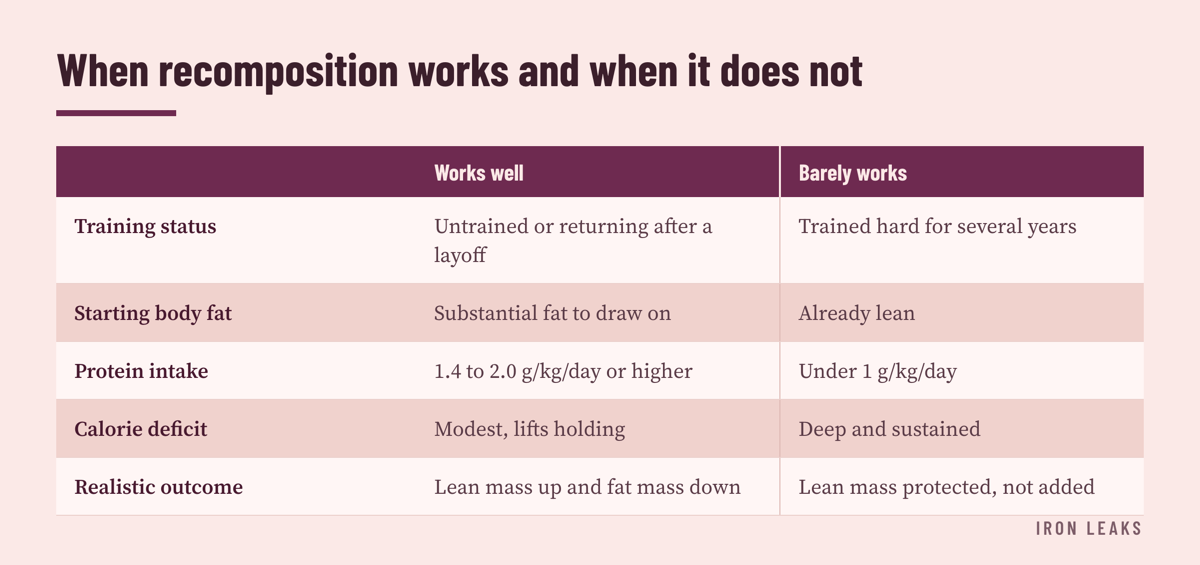
Yes, if you are new to lifting, returning after a layoff, or carrying enough body fat to fuel the process. It gets much harder if you have trained hard for years and are already lean. Age itself is not the variable that decides it. Training status and starting body fat are.
Josse and colleagues showed the effect without any deficit at all, in Medicine and Science in Sports and Exercise. Twenty untrained women trained five days a week for 12 weeks. The milk group gained 1.9 kg of lean mass and lost 1.6 kg of fat. The carbohydrate control gained 1.1 kg of lean mass and lost 0.3 kg of fat, which did not reach significance.
That is what recomposition looks like in an untrained person eating adequate protein: both numbers move at once, without any heroic dieting. The mechanism is not exotic. Untrained muscle responds to almost any competent stimulus, and fat mass falls because training raises expenditure while protein raises satiety.
What do the trials actually show?
Five trials cover most of the useful ground, and putting them side by side makes the pattern obvious. Read the population column first. It predicts the result better than the diet column does.
| Trial | Population | Protein and deficit | Result |
|---|---|---|---|
| Longland et al., Am J Clin Nutr 2016 | 40 young men, 4 weeks | 2.4 against 1.2 g/kg, 40% deficit | +1.2 kg lean and -4.8 kg fat, against +0.1 kg and -3.5 kg |
| Josse et al., Med Sci Sports Exerc 2010 | 20 untrained young women, 12 weeks | Milk after training, no deficit | +1.9 kg lean and -1.6 kg fat, against +1.1 kg and -0.3 kg |
| Verreijen et al., Am J Clin Nutr 2015 | 80 adults with obesity, mean age 63, 13 weeks | 1.11 against 0.85 g/kg, 600 kcal deficit | +0.4 kg appendicular muscle against -0.5 kg, both lost about 3 kg fat |
| Antonio et al., J Int Soc Sports Nutr 2015 | 48 trained lifters, 8 weeks | 3.4 against 2.3 g/kg, no deficit | +1.5 kg fat-free mass in both, -1.7 against -0.3 kg fat |
| Villareal et al., N Engl J Med 2017 | 160 adults with obesity, over 65, 6 months | About 9% body weight lost | Lean mass fell 2% with resistance training, 5% with aerobic only |
The last row is the one nobody quotes. It is also the most instructive.
Who does recomposition actually work for?
Four groups, and the effect is strongest where they overlap. People who have never trained. People returning after months or years away. People with meaningful body fat to lose. And people who are currently underconsuming protein, which is most of the population walking into a gym.
Blocquiaux and colleagues demonstrated the returning-lifter case in Experimental Gerontology. Thirty older men trained 12 weeks, detrained 12 weeks, then retrained. Retraining produced 29% type II fiber hypertrophy and it took under eight weeks to reach their previous one-rep max. Detrained muscle is not the same as untrained muscle.
Body fat matters because stored fat is the energy that fills the gap. Verreijen’s participants averaged a body mass index of 33 and were on a 600 kcal deficit, reported in the American Journal of Clinical Nutrition. The higher-protein group added 0.4 kg of appendicular muscle over 13 weeks while both groups lost about 3 kg of fat.
Who does it barely work for?
Lean, well-trained lifters in a real deficit. This is the judgement call, and most articles will not make it: if you have trained hard for four years and sit at 12% body fat, you should stop trying to do both and pick one. The evidence does not support the promise being sold to you.
Villareal’s six-month trial in the New England Journal of Medicine is the cleanest warning. One hundred and sixty adults with obesity lost about 9% of body weight. The resistance training group still lost 2% of lean mass. Training did not add muscle during that deficit. It reduced how much muscle came off.
That is a legitimate and valuable outcome. It is not recomposition. Anyone in a deep, sustained deficit should expect to protect lean mass rather than build it, and should judge the block by whether their lifts held rather than by whether the DXA scan improved.
How much protein does it take after 40?
The ISSN position stand puts the general range at 1.4 to 2.0 g per kg of body weight per day for building and maintaining muscle in exercising people. For maximizing fat loss in resistance-trained people it discusses 2.3 to 3.1 g/kg/day, which is the band Longland’s successful group sat inside.
The same stand puts the per-serving dose at 0.25 g/kg, or 20 to 40 g absolute, delivering 700 to 3,000 mg of leucine, spread evenly every 3 to 4 hours. For a 90 kg man that is roughly 145 g a day at the middle of the range, in four servings.
Hector and colleagues tested this in the right age band. Forty men and women aged 35 to 65 ran a 14-day deficit of 750 kcal in the Journal of Nutrition. Postprandial muscle protein synthesis fell 9% in the whey group against 28% and 31% in the soy and carbohydrate groups.
Morton and colleagues found the ceiling. Pooling 49 randomized trials in the British Journal of Sports Medicine, total intake beyond 1.62 g/kg/day added no further training-induced fat-free mass. Hitting that number without powder is covered in the 200 g without protein powder guide.
How big should the deficit be?
Smaller than the trials used, because the trials were short and supervised. Longland ran a 40% deficit for four weeks with all food provided and six training days a week. That is a research protocol, not a lifestyle, and nobody has tested whether it holds for six months.
Villareal’s participants averaged about 9% body weight lost across six months, and they lost lean mass doing it. Verreijen used 600 kcal a day for 13 weeks and the higher-protein group gained muscle. The gap between those two results is the deficit size and the duration, not the age of the participants.
Set the deficit so weekly weight loss stays modest and your working weights do not fall. If your lifts drop for two consecutive weeks, the deficit is too large regardless of what the calculator said. The eating guide covers how to set the number.
Does turning 40 change any of this?
It shifts the average slightly and it does not change the conditions. Morton found the fat-free mass benefit of supplementation fell by 0.01 kg per year of age, significant at p=0.002 but small. Peterson, Sen and Gordon’s meta-analysis of 49 studies in adults over 50, published in Medicine and Science in Sports and Exercise, pooled a 1.1 kg lean mass gain.
What does change is recovery capacity and the number of years since you last trained. A 45-year-old who lifted in college and stopped is in the returning category, not the beginner category, and will recompose faster than either the literature average or their own expectations. Newbie gains after 40 covers that distinction.
We check every claim on this site against the trial and the population it was run in. The full method is on the methodology page: the source hierarchy and the checks.
How do you tell it is working?
The scale will not tell you. Recomposition means gaining one tissue and losing another, so body weight can sit still for two months while your waist drops and your lifts climb. That is exactly the pattern to expect and exactly the one that makes people quit.
Track four things monthly: waist at the navel, a single progress photo in the same light, total weekly hard sets, and your top set on two compound lifts. If three of the four improved and the scale did not move, the block worked. The recomposition timeline at 40 covers when each of those signals shows up, and the rate-of-gain pillar covers how much total tissue is on the table.
Questions readers actually ask
Can you really build muscle and lose fat at the same time after 40?
Yes, if you are untrained, returning from a layoff, or carrying meaningful body fat. Longland and colleagues measured 1.2 kg of lean mass gained alongside 4.8 kg of fat lost in four weeks on 2.4 g of protein per kg.
How much protein do you need to recompose after 40?
The ISSN position stand puts the range at 1.4 to 2.0 g per kg per day, and discusses 2.3 to 3.1 g/kg for maximizing fat loss in trained people. Morton found no added fat-free mass beyond 1.62 g/kg/day.
Who should not attempt body recomposition?
Lean, well-trained lifters in a real calorie deficit. Villareal reported that adults losing about 9 percent of body weight still lost 2 percent of lean mass despite resistance training. Training limited the loss rather than adding muscle.
How large should the calorie deficit be?
Small enough that weekly weight loss stays modest and your working weights hold. Verreijen used 600 kcal a day for 13 weeks and the higher-protein group still gained muscle. If lifts fall two weeks running, the deficit is too big.
How do you know recomposition is working if the scale is flat?
Track waist measurement, a monthly progress photo, total weekly hard sets, and your top set on two compound lifts. A flat scale with three of those four improving means the block worked.
Sources
- Longland et al., Am J Clin Nutr 2016. Four-week trial, 40 percent energy deficit, 2.4 against 1.2 g/kg protein, lean gained and fat lost
- Josse et al., Med Sci Sports Exerc 2010. Twelve weeks in untrained women, milk against carbohydrate, 1.9 kg lean gained and 1.6 kg fat lost
- Verreijen et al., Am J Clin Nutr 2015. Eighty adults with obesity, mean age 63, 13 weeks, appendicular muscle preserved on higher protein
- Villareal et al., N Engl J Med 2017. Six-month trial, 160 adults with obesity, lean mass loss by exercise mode during weight loss
- ISSN Position Stand: Jager et al., J Int Soc Sports Nutr 2017. Daily and per-serving protein ranges, leucine content and distribution across the day
- Morton et al., Br J Sports Med 2018. Meta-analysis of 49 trials, the 1.62 g/kg/day plateau and the effect of age on the benefit
Links last checked September 7, 2026.
Every figure above is traced to a named source and re-checked on a monthly cycle. Read how we research.
Independence note. Iron Leaks takes no money from supplement brands, equipment makers or gym chains, and carries no affiliate links. Nothing here is medical advice.
Cole Brennan
Cole Brennan has trained in home gyms since 2013 and has coached lifters through the exact constraints this site is about: one pair of adjustable dumbbells, a low ceiling, a downstairs neighbour, and nobody to spot. He built Iron Leaks after watching the biggest fitness sites answer every question except the one a reader with limited equipment and limited time actually asked. He reads the primary literature rather than other people's summaries of it, and every number he publishes carries a link to where it came from. He is not a doctor and does not pretend to be one.
Keep reading
How Much Muscle Can a 40-Year-Old Gain in 6 Months?
What six-month resistance training trials actually measured, why the second three months add far less than the first, and the range worth…
Do Newbie Gains Still Happen After 40?
Untrained adults past 40 still add muscle in controlled trials. Here is how much smaller the response gets, which muscles are affected,…