Lifting After 40/ September 7, 2026/ 6 min read
How Many Rest Days Does a 50-Year-Old Need Between Workouts?

Roughly 48 hours between hard sessions for the same muscle group, which is not the same as days off per week. The NSCA position statement on resistance training for older adults specifies 2 to 3 nonconsecutive days per week per muscle group. Trained on a split, a 50-year-old can lift four days a week and still give every muscle two full days.
The question almost everyone asks is the wrong unit. Fragala and colleagues, in the NSCA position statement on resistance training for older adults, prescribe frequency per muscle group and not per calendar: 2 to 3 nonconsecutive days per week, per muscle group. The ACSM position stand on progression models scales total sessions by experience instead of age, recommending 2 to 3 days a week for novices, 3 to 4 for intermediates and 4 to 5 for advanced lifters. And Schoenfeld, Ogborn and Krieger’s frequency meta-analysis in Sports Medicine found that when weekly volume is equated, hitting a muscle twice a week beat once a week, with effect sizes of 0.49 against 0.30 and a p value of 0.002.
How many rest days does a 50-year-old need between workouts?
About two days between hard sessions for the same muscle group. That is the number the NSCA statement lands on when it says 2 to 3 nonconsecutive days per week per muscle group, because nonconsecutive across a seven-day week produces roughly 48 to 72 hour gaps.
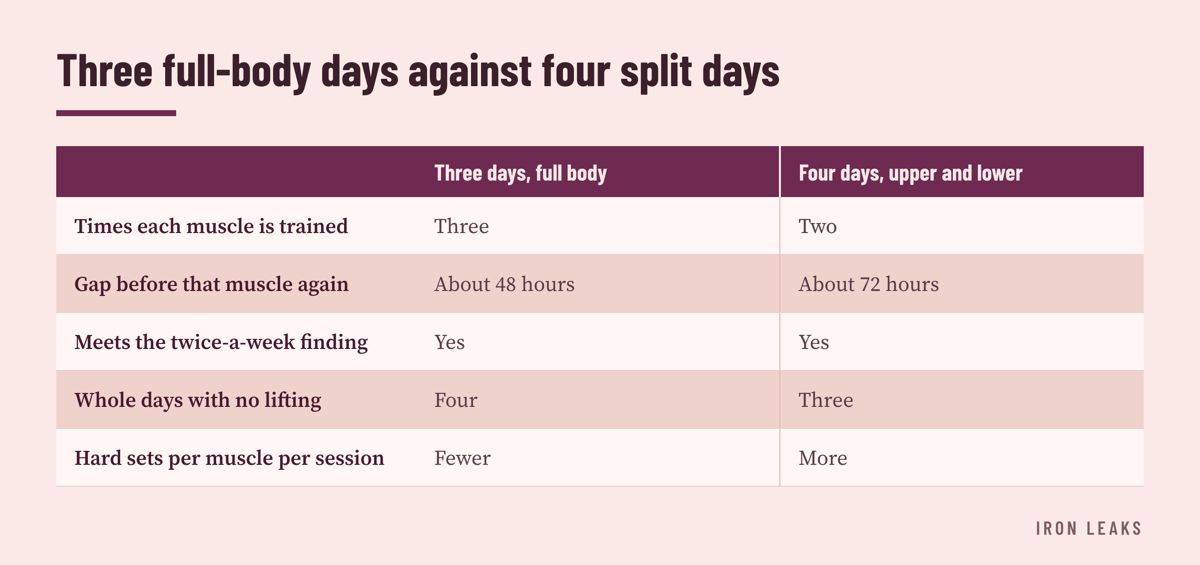
Days off from the gym entirely is a different figure and it depends on how you split the week. A 50-year-old training full body three times takes four days off. A 50-year-old on an upper and lower split trains four days and takes three off. Both give every muscle group the same recovery window. Only one of them looks like “more rest” on a calendar.
Nothing in either position statement sets a different rest interval for a 50-year-old than for a 30-year-old. Age changes the total load you can absorb and how fast you should climb. It does not change the unit of measurement.
Why count rest per muscle group instead of days off per week?
Because frequency and rest are the same variable seen from two ends, and only one of them is tied to an outcome in the literature. Schoenfeld’s frequency meta-analysis compared training muscle groups between 1 and 3 days per week on a volume-equated basis and concluded that major muscle groups should be trained at least twice a week to maximize growth.
That finding forces the arithmetic. Two hits per muscle across seven days means a gap of roughly three days one way and four the other, or a tighter 48 hours if you cluster them. Three hits means gaps closer to 48 hours throughout. Once you fix frequency, rest is decided for you.
The mistake the FAQ pages make is treating rest days as a subtraction from training days. They are not. On an upper and lower split, the day you press is a rest day for your legs. Counting whole days off tells you almost nothing about whether a muscle recovered.
What does a real week look like at 50?
Here are two layouts that both satisfy the NSCA frequency guidance and the Schoenfeld twice-a-week finding. Neither is a beginner template and neither requires seven days of planning. Pick the one that fits the days you can actually get to the gym.
| Day | Three days, full body | Four days, upper and lower |
|---|---|---|
| Monday | Full body A, squat pattern heavy | Lower A, squat pattern heavy |
| Tuesday | Off or easy walking | Upper A, press heavy |
| Wednesday | Full body B, hinge pattern heavy | Off or easy walking |
| Thursday | Off or easy walking | Lower B, hinge pattern heavy |
| Friday | Full body C, press pattern heavy | Upper B, row and chin emphasis |
| Saturday and Sunday | Off, one balance session | Off, one balance session |
The balance session is not filler. Piercy and colleagues, summarizing the second edition of the Physical Activity Guidelines for Americans in JAMA, state that older adults should do multicomponent activity including balance training alongside aerobic and muscle-strengthening work. Ten minutes of single-leg stands and heel-to-toe walking on a non-lifting day covers it.
Does recovery actually get slower after 50?
Less clearly than the internet says. Fell and Williams, reviewing the topic in the Journal of Aging and Physical Activity, describe the belief among older athletes that aging impairs recovery, note the plausible mechanisms, and then point out the problem: studies rarely control for the physical activity level of participants. That makes it difficult to separate the effect of declining activity from the effect of age itself.
What does show up consistently is a smaller adaptive return, not a longer wait. Peterson’s 2011 meta-analysis in Medicine and Science in Sports and Exercise, pooling 49 studies and 1,328 participants aged 50 and over, found a mean lean body mass gain of 1.1 kg, with older individuals experiencing less increase. Smaller gains per unit of work is a different problem from needing an extra day off.
The judgement call: at 50, cut the hard sets before you cut the sessions. Dropping from four sessions to three costs you a full training day and often a whole muscle group’s second weekly hit. Dropping from four heavy sets to two on the squat costs almost nothing and removes most of the recovery debt. That is where the money is.
What makes one rest day enough and another not?
Four things move the number, and none of them is your age. Total hard sets in the session, whether the movement was new, how much eccentric loading it carried, and how you slept.
- Hard set count. Schoenfeld’s dose-response meta-analysis in the Journal of Sports Sciences found each additional weekly set was associated with a 0.37 percent greater gain in muscle size. More sets buy more growth and more recovery cost at the same time.
- Novelty. A movement you have not done in six months produces soreness a movement you do weekly does not.
- Eccentric load. Slow lowering and deep stretch positions cost more than concentric-dominant work.
- Sleep. The one variable most lifters can name and few will fix. Our guide to lifting on five hours of sleep covers what to cut when it goes wrong.
How do you know you rested enough?
Use the first working set as the test, not how you feel walking in. If your first set at the same load moves the same speed and finishes with the same reps in reserve as last time, you recovered. If it is two reps short at the same weight for two sessions running, you did not.
Soreness on its own is a poor signal. It tracks novelty more than it tracks readiness, which is why the question of whether to skip the gym when sore usually resolves to training the sore muscle lighter rather than staying home.
Where this stops being a programming question
Joint pain that is worse three sessions in a row, pain that wakes you at night, or anything sharp and localized is a clinician’s call, not a rest-day calculation. This is an article about scheduling recovery for healthy adults. It is not a treatment plan for an injury.
Should the number change if you also run or cycle?
Yes, in the same direction and by the same logic. The Physical Activity Guidelines ask adults for 150 to 300 minutes a week of moderate aerobic activity, and hard intervals draw on the same legs your squat day does. Put the running on the same day as lower body work, or on the day furthest from it, rather than the day after.
The general shape of frequency, load and recovery at this age is in our pillar on lifting after 40, and the case for keeping load high while trimming set count is in whether it is OK to lift heavy weights after 40. How we choose and check the papers behind all of this is on the methodology page.
Questions readers actually ask
How many days off should a 50-year-old take between workouts?
Count rest per muscle group. The NSCA position statement specifies 2 to 3 nonconsecutive days per week per muscle group, which produces gaps of roughly 48 to 72 hours. Whole days off the gym depends entirely on how you split the week.
Is three days a week enough at 50?
Yes, if it is full body. Three full-body sessions hit every muscle group three times a week, which clears the finding that training a muscle twice a week beats once a week when weekly volume is equated.
Does recovery get slower after 50?
The evidence is less clear than commonly claimed. Fell and Williams found that studies rarely control for participants physical activity level, making it hard to separate aging from declining activity. What is consistent is a smaller adaptive return, not a longer wait.
Can a 50-year-old lift four days a week?
Yes. On an upper and lower split, four training days still give every muscle group about 72 hours between sessions. The day you train upper body is a recovery day for your legs.
Should I train if I am still sore?
Soreness tracks novelty more than readiness. The better test is your first working set: same load, same speed, same reps in reserve means you recovered. Two sessions short at the same weight means you did not.
Sources
- Schoenfeld, Ogborn and Krieger, Effects of Resistance Training Frequency on Measures of Muscle Hypertrophy, Sports Medicine 2016. Volume-equated meta-analysis; training a muscle twice a week beat once a week, effect size 0.49 against 0.30.
- Fragala et al., Resistance Training for Older Adults: Position Statement From the NSCA, Journal of Strength and Conditioning Research 2019. Source of the 2 to 3 nonconsecutive days per week per muscle group frequency recommendation.
- ACSM Position Stand: Progression Models in Resistance Training for Healthy Adults, Medicine and Science in Sports and Exercise 2009. Session frequency scaled by training status: 2 to 3 days for novices, 3 to 4 intermediate, 4 to 5 advanced.
- Fell and Williams, The effect of aging on skeletal-muscle recovery from exercise, Journal of Aging and Physical Activity 2008. Review noting that studies of aging and recovery rarely control for participants physical activity level.
- Peterson et al., Influence of resistance exercise on lean body mass in aging adults, Medicine and Science in Sports and Exercise 2011. 49 studies, 1328 participants aged 50 and over; pooled gain of 1.1 kg, with less increase in older individuals.
- Piercy et al., The Physical Activity Guidelines for Americans, JAMA 2018. Muscle-strengthening on 2 or more days a week, plus balance training as part of multicomponent activity for older adults.
Links last checked September 7, 2026.
Every figure above is traced to a named source and re-checked on a monthly cycle. Read how we research.
Independence note. Iron Leaks takes no money from supplement brands, equipment makers or gym chains, and carries no affiliate links. Nothing here is medical advice.
Cole Brennan
Cole Brennan has trained in home gyms since 2013 and has coached lifters through the exact constraints this site is about: one pair of adjustable dumbbells, a low ceiling, a downstairs neighbour, and nobody to spot. He built Iron Leaks after watching the biggest fitness sites answer every question except the one a reader with limited equipment and limited time actually asked. He reads the primary literature rather than other people's summaries of it, and every number he publishes carries a link to where it came from. He is not a doctor and does not pretend to be one.
Keep reading
Is It OK To Lift Heavy Weights After 40?
Real load numbers instead of opinion: what percentage of your max counts as heavy after 40, and why the rate you add…
How Many Days a Week Should a 45-Year-Old Lift Weights?
A real number with the reasoning behind it, plus a table of 2, 3 and 4-day weeks showing what each one actually…