No, it is not rude. Asking to work in is the standard way gym floors share equipment, and a trained lifter resting over two minutes between sets leaves the machine idle for most of that time anyway. Say “mind if I work in?” during their rest, not mid-set. If they say no, take it and move on.
The rest interval is the whole argument. Grgic, Schoenfeld and colleagues reviewed 23 studies covering 491 participants in Sports Medicine and concluded that resistance-trained lifters need rest periods longer than two minutes to maximize strength gains. Schoenfeld’s own controlled trial in the Journal of Strength and Conditioning Research compared one-minute against three-minute rest across eight weeks and found the three-minute group gained more squat and bench strength and more anterior thigh thickness. So the person on the leg press is, if they are training properly, sitting on it doing nothing for two to three minutes out of every four. That idle window is what working in uses. It is not an imposition; it is the machine’s downtime.
One thing to be clear about before the scripts: there is no research on gym etiquette. The physiology below is cited. The social rules are the editor’s judgement about how commercial gym floors actually run, and reasonable people set the line in slightly different places. Our research method explains where we draw that distinction.
Is it rude to ask to work in on a machine at the gym?
It is not. Working in is the default norm in commercial gyms, and asking is the polite version of the alternative, which is standing three feet away staring until someone feels it. The only rude versions are asking mid-set, taking the machine without asking, and refusing to reset it afterward, all of which come out of the same queue and safety logic behind the standard gym rules.
Here is the judgement call. A machine belongs to whoever is under load on it, not to whoever put a water bottle on the seat and walked to the water fountain. Ownership lasts for the set and the rest that follows it, not for the whole hour. Anyone who treats a shared station as private property for forty minutes is the one breaking the norm, not you.
The practical reason to ask rather than wait: waiting costs you your own rest structure. If you stand around for eight minutes, your session drifts, and drifting sessions are how a 45-minute workout becomes 75. That is a real cost, and it is the same problem that runs through everything in training around a schedule that fights you.
What exactly do you say?
Five words, during their rest, from where they can see you. “Hey, mind if I work in?” That is the entire script. Do not explain your program, do not apologize, and do not lead with how many sets you have left. Short requests get yes; long requests get suspicion.
Timing matters more than wording. Ask when they have racked the weight and are between sets, not while they are pushing and not while they are gasping at the top of a hard set. Step into their eyeline first so the question does not arrive from behind.
If they have headphones in, a small wave and a pointing gesture at the machine works without a word. Most people pull one earbud out. If they do not react, wait for the next rest and try once more, then leave it.
The four lines that cover almost everything
To ask: “Hey, mind if I work in?”
To ask when the settings differ: “Mind if I work in? I will put your pin and seat back each time.”
To answer yes: “Go ahead, I have three sets left. Just move the pin back to twelve when you are done.”
To answer no: “Sorry, I am doing drop sets, I will be about ten minutes.”
What do you do when they say no?
Say “no worries” and walk away. Do not ask how long. Do not hover nearby as a form of pressure. A no is allowed, and roughly half the time it is for a real reason: drop sets, timed rest, a superset you cannot see, or a training partner already on the rotation.
Then substitute. There is almost always a free alternative that trains the same pattern, and swapping is cheaper than waiting. Leg press taken means a goblet squat or a split squat. Lat pulldown taken means a chest-supported row or an assisted pull-up. Chest press taken means dumbbells on a bench.
Substituting is not a compromise on results. Schoenfeld’s volume meta-analysis in the Journal of Sports Sciences found the dose-response for muscle growth tracks weekly sets, at roughly 0.37% additional growth per set. Sets are the currency. Which machine delivered them is not.
When does working in genuinely not work?
Three cases, and they are real rather than excuses. Loaded barbells with a big weight gap. Machines with a slow reset. And supersets, where the person is cycling two stations and never actually leaves either one.
Barbell work is the clearest. If they are squatting 315 and you squat 185, working in means stripping and reloading four plates twice per set. That is more work than the set. Two lifters within about 20 pounds of each other can share a bar comfortably. Beyond that, the plate math kills it, and the same problem is why lifting alone changes your exercise selection at all, which we go through in squatting heavy without a spotter.
Timed rest is the case people forget. A lifter running strict two- or three-minute rest, per the Grgic review’s recommendation for trained individuals, has a stopwatch running. Working in adds forty seconds of transfer time each way and turns a three-minute rest into four. If someone tells you they are on a clock, believe them.
| Situation | Ask to work in? | What to say or do |
|---|---|---|
| Selectorized machine, pin change only | Yes, always | “Mind if I work in?” Move the pin, move it back. |
| Machine needing seat and pad adjustment | Yes, with a note | Photograph or memorize their settings before you touch anything. |
| Loaded barbell, similar weight | Yes | “Are you close to my weight? Happy to share the bar.” |
| Loaded barbell, big weight gap | No | Use a different rack or change the exercise. |
| They are supersetting two stations | No | Take one of the two stations if they are alternating, or move on. |
| They are sitting on it scrolling a phone | Yes | Ask normally. Do not comment on the phone. |
| Water bottle on an empty machine | Use it | Start your set. Step off immediately if they return. |
| Squat rack used for curls at peak hour | Yes | Ask to work in. Do not lecture. It is not your rack either. |
How do you adjust and reset the machine without being annoying?
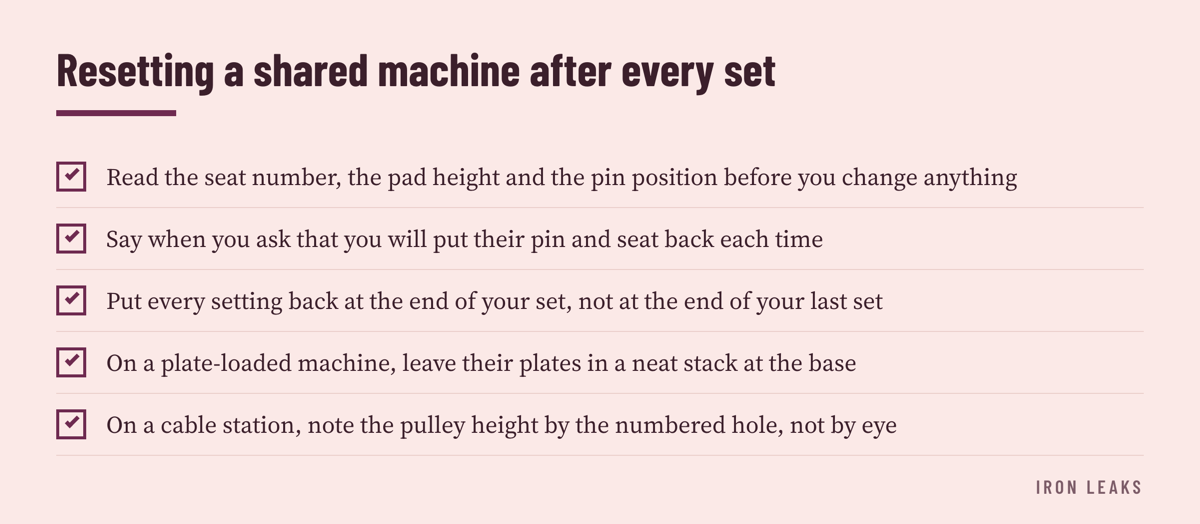
Record their setup before you change it. Read the seat number, the pad height and the pin position, then put every one of them back at the end of your set, not at the end of your last set. That single habit is the difference between a working-in partner people like and one they avoid.
Say it out loud when you ask. “I will put your pin and seat back each time” removes the entire objection before they can raise it. Most refusals are not about sharing; they are about resetting a five-position seat while their rest clock runs.
Two mechanical notes. On a plate-loaded machine, strip to your weight and leave their plates in a neat stack at the base rather than scattered on the floor. On a cable station, note the pulley height by the numbered hole, not by eye. Both take four seconds and save an argument.
What do you say when someone asks to work in with you?
Say yes by default. It costs you nothing on a pin-loaded machine and it takes the rest period you were already taking. Give them the information they need in the same breath: how many sets you have left and what your setting is, so they know the shape of the arrangement.
“Go ahead, I have three sets left, I am on twelve” is the complete answer. Now they know when the station frees up and what to reset the pin to, and neither of you has to ask again.
Say no when it is true, and say why. “I am doing drop sets, about ten minutes” or “I am supersetting with the cable row” is honest and lands fine. A bare no with no reason is the version that makes people think gym culture is hostile, and it is the one habit worth dropping.
One exception where refusing is correct without apology: if the request comes mid-set, or if the person has already started moving your pin. Finish the set, then handle it. Nobody owes a conversation while under load.
Does working in actually cost you anything?
Almost nothing, if you are on a machine. Sharing lengthens your rest slightly, and longer rest is the direction the evidence points anyway for trained lifters. The real cost is the adjustment tax on machines that need a seat change, and that is measured in seconds.
The three-minute rest group in Schoenfeld’s eight-week trial outperformed the one-minute group on squat and bench strength and on thigh thickness, with all other variables held constant. Rest is not dead time you are protecting. Longer is often better.
Where sharing does cost you is frequency and total session length, because a session that runs long is a session you skip next time. Schoenfeld’s frequency work found twice-weekly training beat once-weekly at equated volume, effect size 0.49 against 0.30. Protect the number of sessions, not the sanctity of one machine. If the gym floor is genuinely unworkable at your hour, the honest fix is equipment at home, which is what building muscle with only adjustable dumbbells and lifting without annoying the neighbors downstairs are both about.
Questions readers actually ask
Is it rude to ask to work in on a machine at the gym?
No. Working in is the standard way commercial gym floors share equipment. A trained lifter rests over two minutes between sets, so the machine is idle for most of that window. Ask during their rest, never mid-set.
What is the right way to ask to work in?
Step into their eyeline during a rest period and say: mind if I work in? Five words, no explanation. If the machine needs adjusting, add that you will put their pin and seat back after each set.
What should you do if someone says no?
Say no worries and walk away without asking how long. Then substitute a different exercise that trains the same pattern. Weekly sets drive growth, not which specific machine delivered them.
When is working in a bad idea?
Three cases: a loaded barbell where the weight gap means stripping several plates each set, a machine with a slow multi-point reset, and anyone running a superset across two stations who never leaves either one.
What do you say when somebody asks to work in with you?
Say yes by default and give them the details in the same sentence: how many sets you have left and what your setting is. For example, go ahead, three sets left, I am on twelve.
Sources
- Grgic J, Schoenfeld BJ, et al. Effects of Rest Interval Duration in Resistance Training on Measures of Muscular Strength: A Systematic Review. Sports Medicine 2018;48(1):137-151. Review of 23 studies and 491 participants; rest longer than two minutes is needed to maximize strength gains in resistance-trained lifters.
- Schoenfeld BJ, et al. Longer Interset Rest Periods Enhance Muscle Strength and Hypertrophy in Resistance-Trained Men. J Strength Cond Res 2016;30(7):1805-1812. Eight-week trial; three-minute rest beat one-minute rest for squat and bench strength and anterior thigh thickness.
- Schoenfeld BJ, Ogborn D, Krieger JW. Dose-response relationship between weekly resistance training volume and increases in muscle mass. J Sports Sci 2017;35(11):1073-1082. Graded dose-response; each additional weekly set associated with roughly 0.37% more muscle growth, regardless of which equipment supplied it.
- Schoenfeld BJ, Ogborn D, Krieger JW. Effects of Resistance Training Frequency on Measures of Muscle Hypertrophy. Sports Medicine 2016;46(11):1689-1697. Training a muscle twice weekly outperformed once weekly at equated volume, effect size 0.49 against 0.30.
Links last checked September 7, 2026.
Every figure above is traced to a named source and re-checked on a monthly cycle. Read how we research.
Independence note. Iron Leaks takes no money from supplement brands, equipment makers or gym chains, and carries no affiliate links. Nothing here is medical advice.

Cole Brennan
Cole Brennan has trained in home gyms since 2013 and has coached lifters through the exact constraints this site is about: one pair of adjustable dumbbells, a low ceiling, a downstairs neighbour, and nobody to spot. He built Iron Leaks after watching the biggest fitness sites answer every question except the one a reader with limited equipment and limited time actually asked. He reads the primary literature rather than other people's summaries of it, and every number he publishes carries a link to where it came from. He is not a doctor and does not pretend to be one.
Keep reading
Gym Etiquette Rules for Beginners Nobody Tells You
Every etiquette listicle gives you the rule and none give you the reason. Here is the reason behind each one, so you…
How To Lift Weights on 5 Hours of Sleep
Sleep-science posts tell you to sleep more. This one tells you what to change in tonight's session: what degrades, what to cut,…