
Almost every gym rule is a safety rule, a queue rule, or a noise rule. Strip the bar because a loaded bar tips when the next lifter unloads one side. Step back from the dumbbell rack because you block the whole row. Ask to work in because two to three minute rest periods are normal. Learn the reason and you can handle the situation no list covers.
Weightlifting injuries seen in United States emergency departments rose from an estimated 86,910 a year to 109,961 across a seven-year window, according to Burekhovich and colleagues in the Journal of Long-Term Effects of Medical Implants, who queried the National Electronic Injury Surveillance System. Sprains and strains dominated. The lower trunk accounted for 29.4 percent and the shoulder for 22.6 percent. Roughly half of the standard etiquette list is not manners at all. It is a set of habits that keeps loaded metal from moving when nobody is watching it.
The other half is queue management. A commercial gym is a shared resource with maybe forty stations and two hundred people, and the rules exist so the queue keeps moving. Every listicle gives you the rule. Almost none give you the reason, which is why the moment something happens that is not on the list, you freeze.
Why do gym etiquette rules exist at all?
Three reasons cover all of them. A rule is either preventing an injury, protecting the queue, or holding down noise in a room where noise carries. Nothing on the standard list exists because somebody decided beginners should be humble.
That framing is useful because it tells you which rules bend. Noise rules bend at 6am in an empty gym. Queue rules bend when there are four people on the floor. Safety rules never bend, because the loaded bar does not know how many people are in the room.
When you are unsure, ask which of the three a rule is serving. A beginner who does that stops needing the list. The reasoning transfers to the hotel gym, the apartment gym, and the barbell club with no staff, none of which run by the same posted rules.
What are the gym etiquette rules for beginners nobody explains?
Eight rules cover the overwhelming majority of floor conflicts. Each one has a mechanical reason underneath it, and the reason is what you actually need, because it generalizes to equipment and layouts you have not met yet.
| The rule | Why it exists |
|---|---|
| Strip the bar and rack the plates | A bar left loaded tips off the hooks when the next person pulls a plate from one side. Plates roll, and they roll toward feet. |
| Do not stand right in front of the dumbbell rack | You are not blocking one dumbbell, you are blocking the whole row. Two steps back and everyone behind you can still get in. |
| Return dumbbells to the right numbered slot | People select by number without looking. A 45 filed in the 25 slot costs the next lifter a warm-up set of hunting. |
| Do not walk through someone mid-set | A lifter under load fixes their eyes on one point for balance. Crossing that point moves their head, and the head moves the bar. |
| Ask before changing a machine setup | The pin, the seat height and the safety catches may be set by someone who is thirty seconds into a rest period, not finished. |
| Keep your bag out of the walkway | The walkway is the path people carry loaded dumbbells down. They are looking at the rack, not the floor. |
| Wipe the bench | Shared upholstery, shared skin. This is the one rule that is purely about the next person and nothing else. |
| Lower the dumbbells instead of dropping them | Dropping removes the last part of the lowering phase, which is training you paid for. The noise is the second problem, not the first. |
How long is it acceptable to sit on a machine between sets?
Two to three minutes is normal and defensible. Grgic and colleagues, reviewing 23 studies in Sports Medicine, concluded that rest periods over two minutes are required to maximize strength gains in resistance-trained lifters, while 60 to 120 seconds is enough for untrained people.
Schoenfeld and colleagues tested it directly in the Journal of Strength and Conditioning Research. Twenty-one trained men trained for eight weeks with either one-minute or three-minute rest. The three-minute group gained significantly more on the squat and bench press one-rep max and more thickness in the anterior thigh.
So the person sitting on the leg press staring at nothing for three minutes is not being rude. They are doing the thing the research supports. What is rude is occupying a station while scrolling with no set in progress. The fix in both directions is the same: ask to work in, which is a normal request and not something you need to apologize for. If you are the one being asked during a busy hour, our guide to rest between sets when the gym is packed covers how to shorten rest without losing the session.
What should you actually do in your first five minutes?
Most first-visit friction happens before the first set. You walk in, you do not know where anything is, so you drift, and drifting is what puts you in the wrong place at the wrong time. Six actions remove nearly all of it.
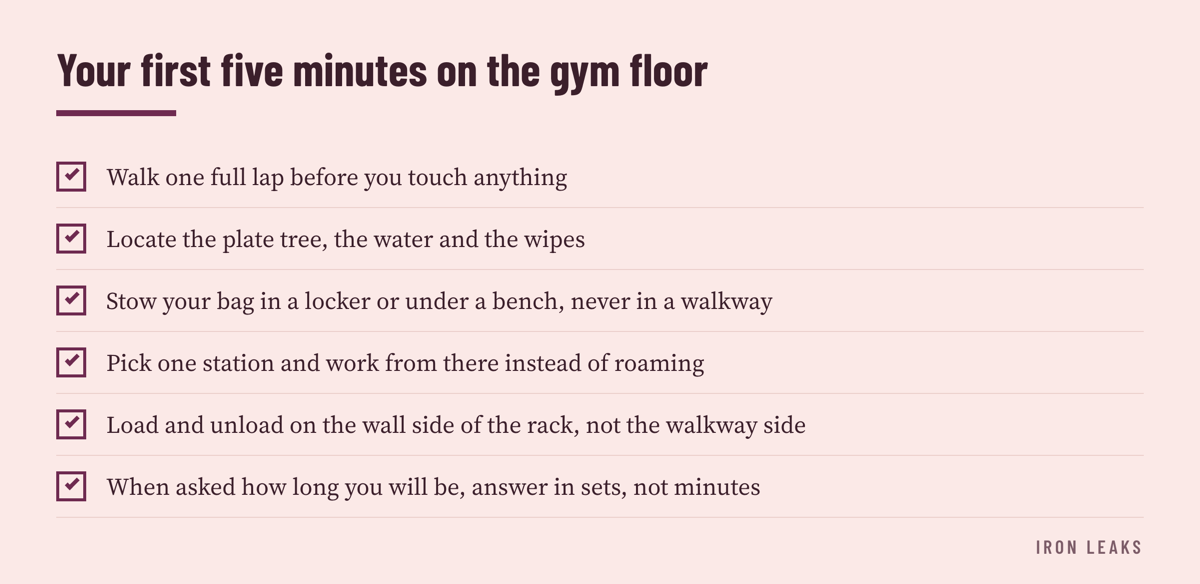
The one that surprises people is the last one. When someone asks how long you will be, answer in sets, not minutes. “Two more sets” is information they can plan around. “About ten minutes” is a number you will be wrong about, and they have to come back and ask again.
Walking a lap first also solves a problem no list mentions: you find out where the plate tree, the water and the wipes are before you need them, so you are not crossing the floor mid-workout. Packing correctly helps too, and what goes in the bag on a first visit is a shorter list than most people expect.
Which rules are safety rules and which are only manners?
Safety rules are the ones where getting it wrong sends metal somewhere. Stripping the bar, clipping collars on, keeping the walkway clear, and staying out of a lifter’s line during a set are all in that group. Break one and the cost lands on a body.
Manners rules are the rest. Wiping the bench, not filming other people, not grunting like a machine failure, not offering unsolicited coaching. Break one and the cost is that somebody’s session is slightly worse.
Pirruccio and Kelly, writing in the International Journal of Sports Medicine, tracked weightlifting shoulder injuries in United States emergency departments and found the national estimate rose from 8,073 to 14,612 over their study window, with 65.1 percent classified as a sprain, strain or muscle tear. Most of those are training errors rather than etiquette failures. But the overlap is real: a bar that shifts because someone walked into your eyeline is a shoulder that catches the load wrong.
What about phones, filming and the mirror?
Filming your own sets is useful. Video is the cheapest form feedback available, and a side-on phone against the wall costs nobody anything.
Here is the editor’s judgement rather than a research finding: a tripod planted in a squat rack is a piece of equipment you did not pay for, in a station somebody is waiting on. Set the phone on the floor, shoot the set, pick it up. If a stranger walks through frame, delete it rather than post it.
Answer in sets, not minutes. Nobody can plan around a number you are going to be wrong about.
The mirror is not a rule, it is a tool. Standing in front of it to check a hinge pattern is what it is for. Standing in front of it while someone behind you is trying to see their own bar path is the thing to avoid, and it takes one glance behind you to know which one you are doing.
What do you do when you break a rule by accident?
Say one sentence and fix it. “Sorry, did not see you,” then move. Nobody in a gym wants a conversation about it, and the extended apology is worse than the original mistake because it costs the other person more time.
The one exception is safety. If you left a loaded bar and someone is already unloading it, say so out loud before they pull the plate. That is the situation where speaking up beats being quietly embarrassed.
Beginners overestimate how much anyone noticed. Most people on the floor are counting reps and watching a clock. The floor is far less judgmental than it looks from the door, and the way to confirm that is to go back a second time.
How do these rules change when the gym is busy?
Queue rules tighten and safety rules stay identical. At peak hour you hold one station instead of two, you do not superset across the room, and you let people work in without making them ask twice.
What does not change is your rest period. Cutting rest to 45 seconds because the room is full costs you strength, which is the finding in both the Grgic review and the Schoenfeld trial above. Better to drop an exercise than to compress every rest period in the session.
Training at an off hour solves the problem outright. Our pillar on training around a schedule that fights you covers how to find one. If the quiet hour you land on is early enough to cost you a night, our guide to lifting on five hours of sleep covers what to change in the session. Grgic and colleagues, in Chronobiology International, found strength is measurably higher in the evening than the morning at baseline, which is part of why the evening is the crowded hour, and also why training in the morning takes a few weeks to feel normal. How we choose and check sources is set out on our methodology page.
The one question that replaces the whole list
Before you do anything on the floor, ask: is this a safety rule, a queue rule, or a noise rule? Safety rules never bend. Queue rules bend when the room is empty. Noise rules bend when nobody is near you. That single question covers gyms with no posted rules, hotel gyms, apartment gyms and barbell clubs.
Questions readers actually ask
Is it rude to sit on a machine for three minutes between sets?
No. Grgic and colleagues concluded in Sports Medicine that rest periods over two minutes are needed to maximize strength gains in trained lifters. Sitting for three minutes between working sets is normal. Scrolling a phone with no set in progress is the actual problem.
Do I have to re-rack my weights if the gym has staff?
Yes. Re-racking is a safety rule, not a courtesy. A bar left loaded tips off the hooks when the next lifter pulls a plate from one side, and loose plates roll toward feet. Staff cannot be at every rack.
What do I say when someone asks how long I will be on a machine?
Answer in sets rather than minutes. Two more sets is information the other person can plan around. A time estimate is almost always wrong, so they have to come back and ask you a second time.
Is filming yourself at the gym acceptable?
Filming your own sets is useful form feedback and generally fine. Keep the phone on the floor rather than occupying a rack with a tripod, and delete anything a stranger walks through instead of posting it.
What happens if I accidentally break a gym rule?
Say one short sentence and fix it. Extended apologies cost the other person more time than the original mistake. The exception is safety: if you left a bar loaded and someone is unloading it, speak up immediately.
Sources
- Burekhovich et al., Journal of Long-Term Effects of Medical Implants 2018. National Electronic Injury Surveillance System estimates of weightlifting injuries presenting to United States emergency departments, and the body parts most often involved.
- Pirruccio and Kelly, International Journal of Sports Medicine 2019. Weightlifting shoulder injuries presenting to United States emergency departments, including the share classified as sprain, strain or muscle tear.
- Grgic et al., Sports Medicine 2018. Systematic review of 23 studies on rest interval duration and chronic strength adaptation, the basis for the two to three minute rest period.
- Schoenfeld et al., Journal of Strength and Conditioning Research 2016. Eight-week trial in trained men comparing one-minute against three-minute interset rest for strength and muscle thickness.
- Grgic et al., Chronobiology International 2019. Meta-analysis of time-of-day resistance training, including the baseline strength difference between morning and evening.
Links last checked September 7, 2026.
Every figure above is traced to a named source and re-checked on a monthly cycle. Read how we research.
Independence note. Iron Leaks takes no money from supplement brands, equipment makers or gym chains, and carries no affiliate links. Nothing here is medical advice.

Cole Brennan
Cole Brennan has trained in home gyms since 2013 and has coached lifters through the exact constraints this site is about: one pair of adjustable dumbbells, a low ceiling, a downstairs neighbour, and nobody to spot. He built Iron Leaks after watching the biggest fitness sites answer every question except the one a reader with limited equipment and limited time actually asked. He reads the primary literature rather than other people's summaries of it, and every number he publishes carries a link to where it came from. He is not a doctor and does not pretend to be one.
Keep reading
How To Lift Weights on 5 Hours of Sleep
Sleep-science posts tell you to sleep more. This one tells you what to change in tonight's session: what degrades, what to cut,…
Is It Rude To Ask To Work In on a Machine at the Gym?
Working in is not rude, it is the norm. The exact wording to use, what to do when the answer is no,…