You can hit 150 grams of protein a day for roughly four to five dollars using eggs, nonfat milk, dried lentils, dried black beans, chicken breast and cottage cheese. Dried lentils deliver roughly 66 grams of protein per dollar at average US prices. Boneless chicken breast delivers 25. The gap between those two numbers is the whole game.
Protein per dollar is a division problem with two verifiable inputs. Grams of protein per 100 grams of food come from USDA FoodData Central. National average retail prices come from the Bureau of Labor Statistics Average Price Data series. Run the division and a pound of dried lentils at 24.6 grams of protein per 100 grams beats a pound of boneless chicken breast at 22.5 grams, because the lentils cost roughly 40 percent as much. Here is the full arithmetic, then a real costed day.
Which cheap foods give you the most protein per dollar?
Dried legumes, by a wide margin. Using USDA protein values and BLS national average prices from when I last checked the series, a dollar of dried lentils buys 66 grams of protein. A dollar of dried black beans buys 58. Nonfat milk and large eggs both buy about 35. Boneless chicken breast buys 25.
| Food | Protein per 100 g | Average US price | Protein per dollar |
|---|---|---|---|
| Lentils, dry | 24.6 g | 1.69 dollars per lb | 66 g |
| Black beans, dry | 21.6 g | 1.69 dollars per lb | 58 g |
| Milk, nonfat | 3.4 g | 3.80 dollars per gal | 35 g |
| Eggs, grade A large | 12.6 g | 2.19 dollars per doz | 35 g |
| Chicken breast, boneless | 22.5 g | 4.15 dollars per lb | 25 g |
The BLS prices dried beans and lentils together under one series for dried beans, any type, so treat those two rows as the same price line. Every price on this page is a national average and yours will differ.
How much protein is in each of these foods?
Every figure below is the Protein value that USDA FoodData Central lists per 100 grams for that food, in the state you buy it. Dry legumes are listed dry, meat is listed raw. That matters, because 100 grams of dry lentils becomes roughly two and a half times its weight once cooked.
| Food, as USDA lists it | Protein per 100 g | A normal serving |
|---|---|---|
| Protein powder, whey based | 78.1 g | 30 g scoop: 23 g |
| Tuna, light, canned in water, drained | 25.5 g | 5 oz can, drained: 36 g |
| Lentils, raw | 24.6 g | 100 g dry: 25 g |
| Chicken breast, boneless, raw | 22.5 g | 6 oz raw: 38 g |
| Peanut butter, smooth, without salt | 22.2 g | 2 tbsp: 7 g |
| Beans, black, mature seeds, raw | 21.6 g | 100 g dry: 22 g |
| Chicken thigh, dark meat, raw | 19.7 g | 6 oz raw: 33 g |
| Tofu, raw, firm, calcium sulfate | 17.3 g | 126 g half block: 22 g |
| Egg, whole, raw | 12.6 g | 1 large egg: 6 g |
| Cottage cheese, lowfat, 1% milkfat | 12.4 g | 1 cup: 28 g |
| Yogurt, Greek, nonfat, plain | 9.5 g | 1 cup: 22 g |
| Milk, nonfat, calcium fortified | 3.4 g | 1 cup: 8 g |
What does a real 150 gram protein day look like?
Six items, four eating windows, about 152 grams. Five of the six have a BLS national average price attached, and those five come to 3.60 dollars. The sixth is cottage cheese, which the BLS does not track, so price it yourself and add it in. Milk is priced from the low-fat and skim milk series. Row values are rounded to the nearest gram.
| When | Food and amount | Protein | Cost |
|---|---|---|---|
| Breakfast | 3 large eggs (150 g) | 19 g | 0.55 dollars |
| Breakfast | 2 cups nonfat milk (490 g) | 17 g | 0.48 dollars |
| Lunch | 100 g dry lentils, cooked | 25 g | 0.37 dollars |
| Dinner | 200 g raw chicken breast | 45 g | 1.83 dollars |
| Dinner | 100 g dry black beans, cooked | 22 g | 0.37 dollars |
| Evening | 200 g cottage cheese, 1% | 25 g | price it locally |
| Total | Six items | about 152 g | 3.60 dollars plus cottage cheese |
That day also clears the per-serving guidance in the ISSN position stand, which puts the dose that maximizes muscle protein synthesis at 0.25 g/kg or an absolute 20 to 40 grams per feeding. Every window here lands inside that band except breakfast, which lands at 36 grams once you combine the eggs and the milk.
How much prep does each of these foods need?
Sort them by minutes, not by price, because the food you never cook has an effective protein content of zero. Canned tuna, milk, cottage cheese, plain Greek yogurt and whey powder need no cooking at all. Eggs need five minutes. Chicken needs about twenty. Tofu needs pressing and ten minutes in a pan.
Dried legumes are the outlier and they are the reason most people skip the cheapest protein on the list. Brown and green lentils cook from dry in under half an hour with no soaking. Dried beans need an overnight soak and an hour or more of simmering, which is why the only sane way to eat them is in batches.
Cook a pound of dry beans at once. That is 454 grams of dry weight carrying 98 grams of protein, and it keeps in the refrigerator for the better part of a week. One pot on a Sunday covers five lunches. Skipping that pot is the single most expensive decision in this whole article.
Which swaps move the needle most?
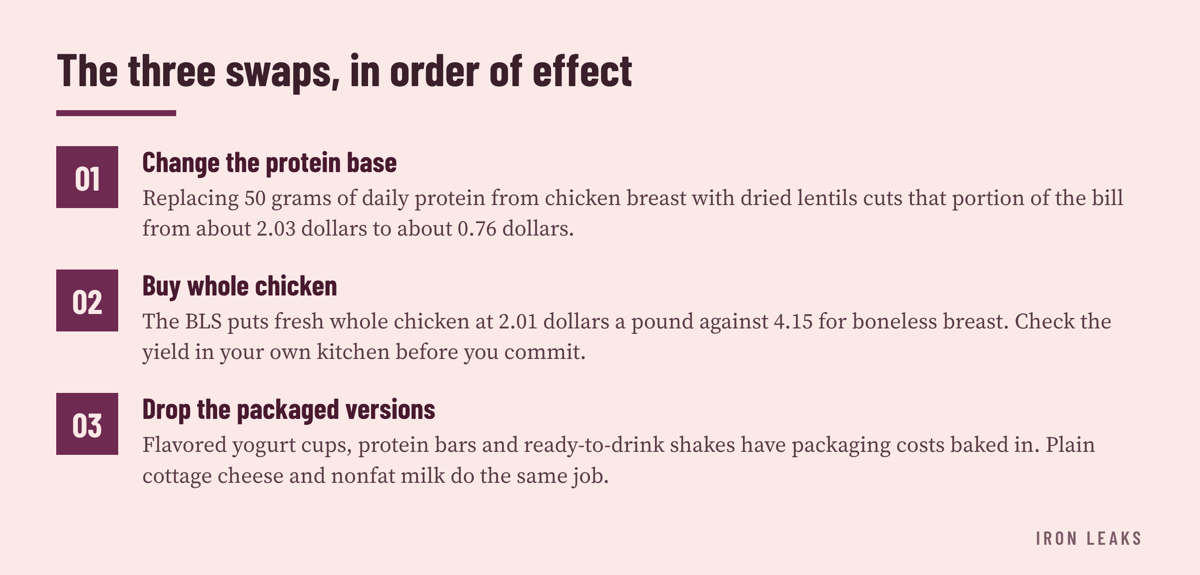
Three, in order of effect. Move your protein base from chicken breast to dried legumes. Buy whole chicken instead of boneless breast. Replace anything sweetened and portion-controlled with a plain dairy staple.
The first swap is worth the most. At the prices above, replacing 50 grams of daily protein from chicken breast with 50 grams from dried lentils cuts that portion of the bill from about 2.03 dollars to about 0.76 dollars. The second is nearly as good: the BLS puts fresh whole chicken at 2.01 dollars a pound against 4.15 for boneless breast. You pay for bone and skin, so check the yield in your own kitchen before you commit.
Dried lentils are the answer, and nobody wants to hear it.
The third swap has no arithmetic behind it, only shelf inspection. Flavored yogurt cups, protein bars and ready-to-drink shakes are sold in small units with packaging costs baked in. A tub of plain cottage cheese and a gallon of nonfat milk do the same job for a fraction of the price per gram.
Do you need a protein powder?
No, but it is not a bad buy. USDA lists whey-based protein powder at 78.1 grams of protein per 100 grams, which is the highest density of anything in the table above. Whether it is cheap depends entirely on the price per pound where you shop, which varies more than any other item here.
Morton and colleagues, pooling 49 trials and 1,863 participants in the British Journal of Sports Medicine, found protein supplementation increased training-induced gains in fat-free mass and one-rep-max strength, but that the benefit disappeared once total daily intake passed 1.62 g/kg. The powder is a delivery method for hitting a total, not a separate ingredient with its own effect.
So treat it the way you would treat a bag of rice. Work out the price per pound, divide by 0.781 to get the price per gram of protein, and compare it against the 66 grams per dollar that dried lentils give you. If it does not win on that number, it is a convenience purchase, and our worked day for 200 grams of protein from food alone shows what the volume looks like without any powder at all.
Why do these prices not match your store?
Because every figure here is a national average from the BLS, calculated across US city averages, and food prices move by region, by season and by chain. The egg series alone ranged from under 1.30 dollars a dozen to over 4.80 dollars a dozen within a few years. Nothing on this page is a promise about your receipt.
Do this instead. Take the protein-per-100-grams column, which does not change, and pair it with the prices on your own shelf. Divide grams of protein per package by the package price. That single number tells you which of two items to put in the cart, and it is the only calculation in this article that has to be done locally.
The USDA Economic Research Service Food Price Outlook publishes category-level price forecasts if you want to see how a category is trending nationally before you shop. Our how we research page explains how we check every figure on this site.
What should you buy this week?
One pound of dried lentils, one pound of dried black beans, two dozen eggs, a gallon of nonfat milk, two pounds of chicken and a tub of cottage cheese. That list covers several days at 150 grams and costs less than two restaurant meals.
Then set the target properly. Our pillar on protein and calories for lifters shows how to derive your own daily number from body weight, and why 150 grams happens to be close to the right figure for a 200 pound lifter. If you are eating well and still not gaining, the problem is usually calories or training volume, not protein. Our guide to how many calories to add for a lean bulk gives the surplus to start from, and how much muscle you can actually build naturally sets the expectation.
This is general nutrition information for healthy adults who lift, not clinical advice. If you are managing a medical condition, are pregnant, or have a history of disordered eating, take these numbers to a registered dietitian before acting on them. Older lifters working through the same math will find the age-specific version in our guide to results from lifting at 50, and the rest of the food guides sit in the Eating for Lifters section.
Questions readers actually ask
What is the cheapest source of protein per dollar?
Dried lentils. Using USDA protein values and BLS national average prices, a dollar of dried lentils buys about 66 grams of protein, against 58 for dried black beans, 35 for eggs or nonfat milk, and 25 for boneless chicken breast.
How much does 150 grams of protein a day cost?
Roughly four to five dollars at US national average prices. Three eggs, two cups of nonfat milk, 100 g of dry lentils, 200 g of raw chicken breast and 100 g of dry black beans total 3.60 dollars, plus a tub of cottage cheese.
How much protein is in 100 grams of dried lentils?
USDA FoodData Central lists raw lentils at 24.6 grams of protein per 100 grams. That is more per 100 grams than raw boneless chicken breast, which USDA lists at 22.5 grams, and dried lentils cost far less per pound.
Do I need protein powder to hit 150 grams a day?
No. USDA lists whey-based protein powder at 78.1 grams of protein per 100 grams, so it is dense and convenient, but a day built from eggs, milk, legumes, chicken and cottage cheese clears 150 grams without it.
Why do these food prices not match my grocery store?
Every price here is a BLS US city average, and food prices vary by region, season and chain. The USDA protein-per-100-grams figures do not change, so pair those with your own shelf prices to compare items.
Sources
- USDA FoodData Central. Source for every protein-per-100-grams figure on this page, using SR Legacy entries.
- BLS Consumer Price Index Average Price Data. Source for US city average retail prices of eggs, milk, dried beans and chicken breast.
- BLS series APU0000708111, eggs grade A large per dozen. The specific average price series used for the egg cost in the costed day.
- USDA Economic Research Service Food Price Outlook. Category-level US food price forecasts and historical price change data.
- ISSN Position Stand: Protein and Exercise (Jager et al., 2017). Per-serving protein dose of 0.25 g/kg or an absolute 20 to 40 grams to maximize muscle protein synthesis.
- Morton et al., British Journal of Sports Medicine 2018. Meta-analysis of 49 trials; protein supplementation benefit disappears above a total intake of 1.62 g/kg per day.
Links last checked September 7, 2026.
Every figure above is traced to a named source and re-checked on a monthly cycle. Read how we research.
Independence note. Iron Leaks takes no money from supplement brands, equipment makers or gym chains, and carries no affiliate links. Nothing here is medical advice.

Cole Brennan
Cole Brennan has trained in home gyms since 2013 and has coached lifters through the exact constraints this site is about: one pair of adjustable dumbbells, a low ceiling, a downstairs neighbour, and nobody to spot. He built Iron Leaks after watching the biggest fitness sites answer every question except the one a reader with limited equipment and limited time actually asked. He reads the primary literature rather than other people's summaries of it, and every number he publishes carries a link to where it came from. He is not a doctor and does not pretend to be one.
Keep reading
How To Get 200g of Protein a Day Without Protein Powder
A worked day of eating that totals 200 grams of protein from whole foods, built on USDA FoodData Central values, with the…
How Many Calories To Add for a Lean Bulk per Week
A weekly adjustment rule for a lean bulk: the starting surplus, the gain rate to target, the three-week check, and what to…