
Start at 250 calories a day above maintenance, which is about 1,750 a week. Aim to gain 0.25 percent of your body weight per week, so roughly half a pound at 200 pounds. Weigh daily, compare your week one average to your week three average, then move the surplus by 200 calories in whichever direction the scale says.
There is no validated number for how big a bulking surplus should be. Slater and colleagues, reviewing the question in Frontiers in Nutrition, state plainly that the specific energy surplus required to facilitate muscle hypertrophy is unknown, and that textbook estimates have never been validated in a resistance training population. What has been measured is what happens when the surplus is too big. That trial exists, the result is unflattering, and it is the reason this guide starts small and adjusts weekly instead of handing you a calculator output.
How many calories should you add for a lean bulk?
Start with 250 a day. That is a deliberate low opening bid, not a precise dose, and the point of it is that it is small enough to correct before it costs you months of fat gain. Over a week it is 1,750 calories. Over four weeks it is 7,000.
The case for opening small comes from Garthe and colleagues in the European Journal of Sport Science. They randomized 39 elite athletes to either nutritional counseling with a planned energy surplus or ad libitum eating, and ran both groups through an added four strength sessions a week for 8 to 12 weeks.
| Measure | Counseled group, n=21 | Ad libitum group, n=18 |
|---|---|---|
| Daily energy intake | 3,585 kcal | 2,964 kcal |
| Body weight change | Up 3.9 percent | Up 1.5 percent |
| Fat mass change | Up 15 percent | Up 3 percent |
| Lean body mass gain | No significant difference | No significant difference |
| One-rep-max strength | Improved 6 to 12 percent | Improved 6 to 12 percent |
Read the third and fourth rows together. The group eating roughly 620 more calories a day put on five times the fat mass and no extra lean mass. That is the entire argument for a small surplus in one line of data.
How fast should you gain weight on a lean bulk?
About 0.25 percent of body weight per week. At 200 pounds that is half a pound a week, or roughly two pounds a month. Garthe’s counseled athletes gained 3.9 percent of body weight in 8 to 12 weeks, which works out to between 0.33 and 0.49 percent per week, and their fat mass rose 15 percent for it.
| Body weight | 0.25 percent per week | 0.5 percent per week |
|---|---|---|
| 150 lb | 0.4 lb | 0.8 lb |
| 175 lb | 0.4 lb | 0.9 lb |
| 200 lb | 0.5 lb | 1.0 lb |
| 225 lb | 0.6 lb | 1.1 lb |
Treat 0.5 percent per week as the ceiling, not the target. Above it you are buying weight, and the Garthe data says a large share of that weight is fat. Below 0.25 percent per week the surplus is probably too small to matter, and you are just eating carefully for no return.
How do you check the surplus after three weeks?
Weigh yourself every morning, same conditions, and compare seven-day averages rather than single readings. Take the average of days 1 through 7 and the average of days 15 through 21. The difference across those two weeks, divided by two, is your weekly rate.
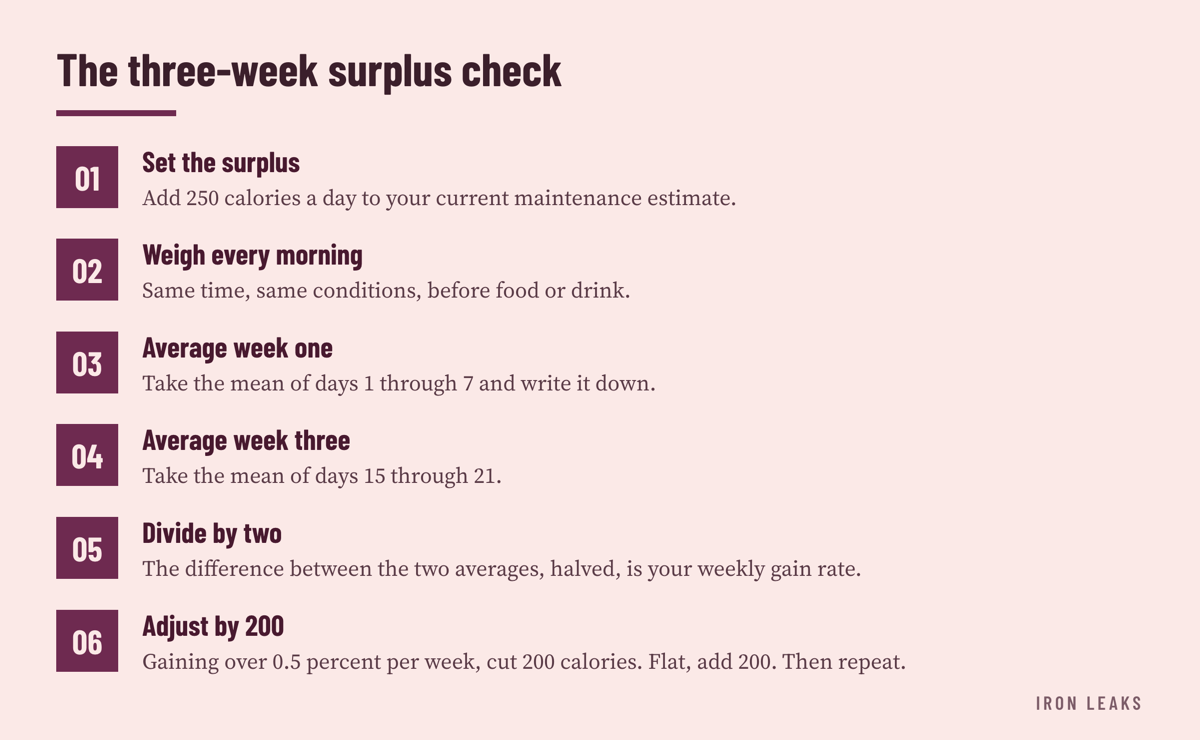
Three weeks is the shortest window that gives a usable signal. Body weight swings by several pounds day to day on water, sodium, glycogen and gut contents, and a two-week comparison is still mostly noise. A single Monday-to-Monday reading tells you nothing at all.
Do not change anything during those three weeks. If you adjust calories in week two, the week three number is measuring two different diets and you have thrown away the experiment. Hold the surplus, log the weight, wait.
What do you change if you are gaining too fast?
Cut 200 calories a day and run another three weeks. Do not cut 500, and do not switch to a deficit because one week looked bad. The correction should be smaller than the surplus you are correcting, so the next three-week block still gives you a clean reading.
Take the calories out of fat and carbohydrate, never protein. Protein sets the ceiling on how much of the surplus turns into muscle, and cutting it to make room for the adjustment defeats the entire purpose of the block.
If you have made two consecutive 200 calorie cuts and are still gaining above 0.5 percent per week, your maintenance estimate was wrong by more than 400 calories. That happens. Stop adjusting from the original estimate and rebuild it: eat at the current intake for three weeks, confirm the weight is flat, and call that number maintenance.
What if the scale has not moved at all?
Add 200 calories a day and run three more weeks. A flat scale after three weeks at a 250 calorie surplus means one of two things, and both have the same fix. Either your maintenance was underestimated, or you are not eating what you think you are eating.
The second is more common than lifters like to admit. Cooking oil, dressings, drinks and untracked bites move a day by several hundred calories. Before you add anything, weigh your food for one week and compare the logged total to what you assumed.
Activity also adjusts itself. A surplus tends to raise spontaneous movement, and appetite drops back. That is the honest reason a surplus that worked in month one stops working in month three, and it is why the check runs on a loop rather than once.
How much protein do you need on a lean bulk?
Between 1.4 and 2.0 grams per kilogram of body weight per day. That is the range the ISSN position stand gives for building and maintaining muscle in exercising people, published in the Journal of the International Society of Sports Nutrition. At 200 pounds, or 91 kilograms, that is 127 to 182 grams a day, and the cheapest route to the low end of that range is set out in our ranking of which foods give the most protein per dollar.
Morton and colleagues, pooling 49 trials and 1,863 participants in the British Journal of Sports Medicine, found that added protein produced no further gain in fat-free mass once total intake passed 1.62 grams per kilogram per day. So there is a ceiling, and it sits inside the ISSN range rather than above it.
Set protein first, then let carbohydrate and fat carry the surplus. Portion sizes for that come from USDA FoodData Central rather than a label estimate. Our pillar on protein and calories for lifters works through deriving your own number, and if you want that protein from food rather than powder, our worked day for 200 grams without protein powder shows what the volume looks like.
Why do the calorie calculators disagree with each other?
Because every one of them is running an estimating equation on the same four inputs, and the equations differ. Height, weight, age and an activity multiplier cannot capture your job, your step count, your sleep or your non-exercise movement. The activity multiplier alone swings the output by several hundred calories.
The calculator is guessing. Your scale is measuring. After three weeks, stop listening to the calculator.
The Frontiers in Nutrition review makes the same point from the research side: the estimates behind those equations have never been validated in lifters. Use a calculator once, to get a starting point you can be wrong about cheaply. Then never open it again. Every adjustment after week three should come from your own seven-day averages, which are specific to you in a way no equation is.
What this guide will not do
It will not give you a body-fat percentage target, a macro split to the gram, or a promise about how much muscle the block will add. Those numbers vary too much between individuals to state as fact. Our how we research page explains what we cite and what we refuse to.
How long should a lean bulk run?
Long enough to complete at least four three-week checks, which is twelve weeks minimum. The Garthe intervention ran 8 to 12 weeks and produced measurable body composition change in both arms, so that is a reasonable floor for a block that is meant to do something.
End it on a number, not a feeling. Pick a body weight or a waist measurement in advance and stop when you reach it. Ending a bulk because you feel soft in month five, after five months of unchecked drift, is how a lean bulk becomes a regular one.
Rest days are the other place a well-set surplus quietly goes wrong. Our guide to calories on rest days when bulking explains why the weekly total is what you are actually managing, and what to do if you would rather cycle the intake by day.
Questions readers actually ask
How many calories should you add for a lean bulk?
Start at 250 calories a day above maintenance, which is 1,750 a week. That opening figure is deliberately small so it can be corrected quickly. Adjust it by 200 calories in either direction after comparing three weeks of daily weigh-in averages.
How fast should you gain weight on a lean bulk?
About 0.25 percent of body weight per week, which is half a pound at 200 pounds. Treat 0.5 percent per week as a ceiling. Garthe and colleagues found that elite athletes gaining 3.9 percent of body weight over 8 to 12 weeks added 15 percent to their fat mass with no extra lean mass.
How long before you adjust bulking calories?
Three weeks. Body weight swings several pounds a day on water and gut contents, so compare the average of days 1 to 7 against the average of days 15 to 21. Change nothing during the three weeks or the comparison is worthless.
What do you do if you are gaining too fast on a bulk?
Cut 200 calories a day and run another three-week block. Take the reduction from carbohydrate and fat, never from protein. If two consecutive cuts have not slowed the gain, your maintenance estimate was wrong and needs rebuilding from scratch.
How much protein do you need while bulking?
The ISSN position stand puts the range at 1.4 to 2.0 grams per kilogram of body weight per day, which is 127 to 182 grams for a 200 pound lifter. Morton and colleagues found no further fat-free mass benefit above 1.62 grams per kilogram.
Sources
- Garthe et al., European Journal of Sport Science 2013. Randomized trial in 39 elite athletes comparing a counseled energy surplus against ad libitum intake over 8 to 12 weeks.
- Slater et al., Frontiers in Nutrition 2019. Review concluding that the specific energy surplus required for hypertrophy is unknown and unvalidated.
- ISSN Position Stand: Protein and Exercise (Jager et al., 2017). Journal of the International Society of Sports Nutrition; daily protein range for exercising people.
- Morton et al., British Journal of Sports Medicine 2018. Meta-analysis of 49 trials; protein benefit to fat-free mass plateaus at 1.62 g/kg/day.
Links last checked September 7, 2026.
Every figure above is traced to a named source and re-checked on a monthly cycle. Read how we research.
Independence note. Iron Leaks takes no money from supplement brands, equipment makers or gym chains, and carries no affiliate links. Nothing here is medical advice.

Cole Brennan
Cole Brennan has trained in home gyms since 2013 and has coached lifters through the exact constraints this site is about: one pair of adjustable dumbbells, a low ceiling, a downstairs neighbour, and nobody to spot. He built Iron Leaks after watching the biggest fitness sites answer every question except the one a reader with limited equipment and limited time actually asked. He reads the primary literature rather than other people's summaries of it, and every number he publishes carries a link to where it came from. He is not a doctor and does not pretend to be one.
Keep reading
How To Get 200g of Protein a Day Without Protein Powder
A worked day of eating that totals 200 grams of protein from whole foods, built on USDA FoodData Central values, with the…
How To Hit 150g of Protein a Day on a Budget
A costed day of eating that clears 150 grams of protein, built from USDA protein values and BLS average retail prices, with…