Eating for Lifters/ September 7, 2026/ 7 min read
How To Get 200g of Protein a Day Without Protein Powder

Six whole-food servings get you there: four eggs, a cup of Greek yogurt, 170 g of cooked chicken breast, a can of tuna, 140 g of cooked lean ground beef and a cup of cottage cheese. That is 200 grams of protein, about 1,290 calories, and roughly 2.4 pounds of food you have to chew.
Protein powder is a shortcut, not a requirement. A 30 gram scoop of whey delivers about 23 grams of protein in four seconds of shaking. Getting the same 23 grams from cooked chicken breast means 74 grams of meat, which USDA FoodData Central lists at 31.0 grams of protein per 100 grams. Do that eight times in a day and you have 200 grams. You also have a lot of chewing, a lot of dishes and a real planning problem. Here is the arithmetic, then a day that actually totals 200.
How do you get 200 grams of protein a day without protein powder?
Six servings across six eating windows, using nothing but food. Every protein figure below is the value USDA FoodData Central lists per 100 grams for that food in the state you eat it. The day lands at 200 grams of protein and 1,288 calories, which leaves most of a normal calorie budget free for carbohydrate and fat.
| When | Food and amount | Protein | Calories |
|---|---|---|---|
| Breakfast | 4 large eggs, 200 g | 25 g | 286 |
| Mid-morning | 1 cup plain nonfat Greek yogurt, 227 g | 22 g | 123 |
| Lunch | Cooked chicken breast, 170 g | 53 g | 281 |
| Afternoon | 1 can light tuna in water, drained, 142 g | 36 g | 165 |
| Dinner | Cooked 93 percent lean ground beef, 140 g | 37 g | 270 |
| Evening | 1 cup 1 percent cottage cheese, 226 g | 28 g | 163 |
| Total | Six items, 1,105 g of food | 200 g | 1,288 |
Nothing in that list is exotic and nothing needs a blender. Five of the six items require either no cooking or under ten minutes. The chicken and the beef are the only real cooking, and both batch well.
Which whole foods carry the most protein per serving?
Cooked lean meat and fish, in that order, and it is not close. USDA FoodData Central puts cooked chicken breast at 31.0 grams of protein per 100 grams, broiled 93 percent lean ground beef at 26.2, drained light tuna canned in water at 25.5, cooked shrimp at 24.0 and cooked farmed Atlantic salmon at 22.1.
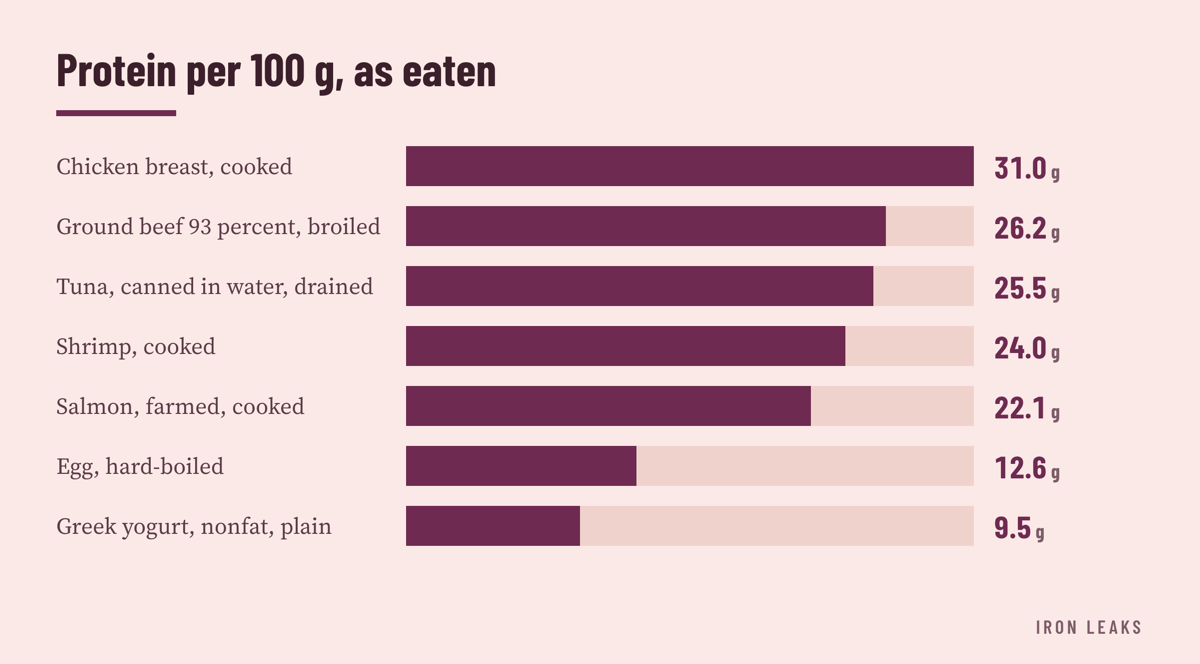
Dairy and eggs sit a full tier below. A hard-boiled egg is 12.6 grams of protein per 100 grams, which works out to about 6 grams for one large egg. Plain nonfat Greek yogurt is 9.53 grams per 100 grams. Cottage cheese at 1 percent milkfat is 12.4.
That gap is why a no-powder 200 gram day has to be built on meat and fish. Dairy and eggs are the filler that closes the last 50 grams, not the base. If you try to run the whole day on yogurt you will need roughly five pounds of it.
Which foods give you the most protein per calorie?
Shrimp and canned tuna win, and they win by a wide margin. Divide the USDA protein value by the USDA calorie value and cooked shrimp returns 24.2 grams of protein per 100 calories. Drained canned tuna returns 22.0. Whole eggs return 8.1, which is the worst number in the table by a factor of three.
| Food, as USDA lists it | Protein per 100 g | Calories per 100 g | Protein per 100 kcal |
|---|---|---|---|
| Shrimp, cooked | 24.0 g | 99 | 24.2 g |
| Tuna, light, canned in water, drained | 25.5 g | 116 | 22.0 g |
| Chicken breast, cooked, roasted | 31.0 g | 165 | 18.8 g |
| Yogurt, Greek, nonfat, plain | 9.5 g | 54 | 17.6 g |
| Cottage cheese, lowfat, 1 percent | 12.4 g | 72 | 17.2 g |
| Beef, ground, 93 percent lean, broiled | 26.2 g | 193 | 13.6 g |
| Salmon, Atlantic, farmed, cooked | 22.1 g | 206 | 10.7 g |
| Egg, whole, hard-boiled | 12.6 g | 155 | 8.1 g |
This column matters more than the protein column when you are cutting. Salmon and eggs are excellent food and terrible protein-per-calorie vehicles, because the fat rides along. Swap two of the four breakfast eggs for a second serving of shrimp or tuna and you keep the protein while cutting roughly 100 calories.
How much food is 200 grams of protein without powder?
About 2.4 pounds. The day in the table above weighs 1,105 grams before you add any vegetables, rice, fruit or oil. Add a normal amount of carbohydrate and produce on top and you are eating four to five pounds of food across the day.
That volume, not the cost and not the cooking, is the actual reason people quit a no-powder protein target. A shake is 300 milliliters and takes no stomach space. Two hundred grams of cottage cheese sits there for an hour.
Three things make the volume manageable. Spread it over five or six windows instead of three. Lean hard on the high-density column, because chicken breast and tuna carry protein in the least food. Drink some of it as milk rather than eating another solid meal.
Do you actually need 200 grams of protein a day?
Probably not, unless you are heavy. The ISSN position stand published in the Journal of the International Society of Sports Nutrition puts the range for building and maintaining muscle at 1.4 to 2.0 grams per kilogram of body weight per day. At 2.0 g/kg, 200 grams is the target for a 100 kilogram lifter, which is 220 pounds.
Below that body weight, 200 grams is above the range. Morton and colleagues, pooling 49 trials in the British Journal of Sports Medicine, found that added protein stopped producing further gains in fat-free mass once total intake passed 1.62 g/kg per day. For a 180 pound lifter that ceiling is about 132 grams.
Two hundred is a round number, not a physiological threshold.
The one case where the higher figure earns its keep is a hard cut. The same ISSN stand discusses 2.3 to 3.1 g/kg for maximizing fat loss in resistance-trained people who are dieting. If you are lean, dieting and lifting, 200 grams is defensible at a much lower body weight.
How should you spread 200 grams across the day?
Evenly, in four to six feedings, every three to four hours. The ISSN position stand puts the per-serving dose that maximizes muscle protein synthesis at 0.25 grams per kilogram of body weight, or an absolute 20 to 40 grams, delivering 700 to 3,000 milligrams of leucine. It also recommends distributing total intake evenly across the day.
Check the day in the table against that rule. Breakfast lands at 25 grams, mid-morning at 22, the afternoon can at 36, dinner at 37 and the evening cottage cheese at 28. Five of the six windows sit inside the 20 to 40 gram band.
Lunch is the exception. One hundred and seventy grams of cooked chicken delivers 53 grams in one sitting, which overshoots. Split it: 100 grams at lunch and 70 grams two hours later, and every window in the day fits the guidance.
What if you do not eat meat?
The arithmetic gets harder but it does not break. Plant sources carry less protein per 100 grams and far less per 100 grams of total food, because the fiber and starch come along. Cooked lentils are 9.0 grams of protein per 100 grams and cooked black beans are 8.9, against 31.0 for chicken breast.
That ratio means a plant-based 200 gram day is roughly three times the food volume of the meat-based day above, unless you use dairy and eggs to carry the density. Our guide to hitting protein goals on a plant-based diet without powder works through the swaps.
If you are cutting out both meat and dairy and still targeting 200 grams while training hard, that is a case for a registered dietitian rather than a blog. The volume becomes a genuine planning problem, not a motivation problem.
What breaks a 200 gram day?
Three things, in order. Skipping a window, because you cannot make up 35 grams later without an unpleasant meal. Under-portioning meat, because a raw chicken breast that looks like 200 grams is often 140. Buying protein in small units that cost a lot and deliver little.
Weigh the meat raw for two weeks until your eye is calibrated. Note that USDA lists raw and cooked separately for a reason: raw skinless chicken breast is 22.5 grams of protein per 100 grams and cooked is 31.0, because water leaves. If you weigh raw and read the cooked number you will overcount by nearly 40 percent.
Where these numbers come from
Every protein and calorie figure on this page is the value published by USDA FoodData Central for the SR Legacy entry named in the table. Nothing here is estimated from a label or a brand website. Our how we research page explains the source hierarchy we use and what we refuse to cite.
What should you do first?
Set the target before you chase the number. Our pillar on protein and calories for lifters shows how to derive your own daily figure from body weight, and for most lifters it lands well under 200 grams. If it lands at 150, our costed guide to hitting 150 grams a day on a budget prices the cheapest route.
Then buy for density, not for variety. A week of the day above is roughly 1.2 kilograms of chicken breast, 7 cans of tuna, 28 eggs, 1.6 kilograms of yogurt, 1 kilogram of ground beef and 1.6 kilograms of cottage cheese. That is one shopping trip and two cooking sessions.
And if you are adding calories on top of this to gain, read how many calories to add for a lean bulk before you start, because a 1,288 calorie protein base leaves a lot of room to get the surplus wrong.
Questions readers actually ask
Can you get 200 grams of protein a day from food alone?
Yes. Four large eggs, a cup of plain nonfat Greek yogurt, 170 grams of cooked chicken breast, a drained can of light tuna, 140 grams of cooked 93 percent lean ground beef and a cup of 1 percent cottage cheese total 200 grams of protein and 1,288 calories.
Which food has the most protein per calorie?
Cooked shrimp, at 24.2 grams of protein per 100 calories using USDA FoodData Central values. Drained light tuna canned in water follows at 22.0 grams, and cooked chicken breast at 18.8. Whole eggs are the weakest of the common options at 8.1 grams.
How much food is 200 grams of protein without powder?
About 2.4 pounds, or 1,105 grams, before you add any vegetables, grains or fat. Volume is the main obstacle rather than cost. Spreading the total across five or six eating windows and favoring lean meat and fish makes it manageable.
Do you need 200 grams of protein a day to build muscle?
Only if you are heavy. The ISSN position stand puts the range at 1.4 to 2.0 grams per kilogram per day, so 200 grams matches a 220 pound lifter at the top of that range. Morton and colleagues found no further fat-free mass benefit above 1.62 grams per kilogram.
How many grams of protein should each meal have?
Between 20 and 40 grams, or 0.25 grams per kilogram of body weight, every three to four hours according to the ISSN position stand. That means four to six feedings to reach 200 grams, not three large meals.
Sources
- USDA FoodData Central. Source of every protein and calorie value in the tables, using SR Legacy entries.
- ISSN Position Stand: Protein and Exercise (Jager et al., 2017). Journal of the International Society of Sports Nutrition; daily range, per-serving dose and distribution guidance.
- Morton et al., British Journal of Sports Medicine 2018. Meta-analysis of 49 trials; no further fat-free mass benefit above 1.62 g/kg/day.
Links last checked September 7, 2026.
Every figure above is traced to a named source and re-checked on a monthly cycle. Read how we research.
Independence note. Iron Leaks takes no money from supplement brands, equipment makers or gym chains, and carries no affiliate links. Nothing here is medical advice.
Cole Brennan
Cole Brennan has trained in home gyms since 2013 and has coached lifters through the exact constraints this site is about: one pair of adjustable dumbbells, a low ceiling, a downstairs neighbour, and nobody to spot. He built Iron Leaks after watching the biggest fitness sites answer every question except the one a reader with limited equipment and limited time actually asked. He reads the primary literature rather than other people's summaries of it, and every number he publishes carries a link to where it came from. He is not a doctor and does not pretend to be one.
Keep reading
How Many Calories To Add for a Lean Bulk per Week
A weekly adjustment rule for a lean bulk: the starting surplus, the gain rate to target, the three-week check, and what to…
How To Hit 150g of Protein a Day on a Budget
A costed day of eating that clears 150 grams of protein, built from USDA protein values and BLS average retail prices, with…