Train, but change the session. On restricted sleep you lose bar speed long before you lose workload: Knowles and colleagues recorded lower-body bar velocity falling up to 15 percent while total volume load dropped under 1 percent, and session perceived exertion rose 11 percent. Keep your sets. Cut the top-end load, drop anything technical, add a minute of rest, and train earlier in the day than usual.
Craven and colleagues pooled 227 outcome measures from 69 publications in Sports Medicine and found acute sleep loss cut exercise performance by a mean of 7.56 percent, with a further decrease of roughly 0.4 percent for every additional hour awake before the task. Knowles and colleagues, writing in Medicine and Science in Sports and Exercise, put nine nights of five-hour sleep opportunity against normal sleep in trained women and watched exactly which markers moved. Volume load barely shifted. Bar velocity, effort and cortisol all did. That split is the whole article.
Every ranking page on this query tells you to sleep more. You already know that. The question you typed is what to do with the session in front of you, tonight, on the sleep you actually got.
Should you train at all on five hours of sleep?
Yes, in almost every case. The performance cost is real but it is a percentage, not a wipeout, and skipping the session costs you the whole session. Craven’s meta-analysis in Sports Medicine found significant negative effects across every exercise category, at a pooled mean of 7.56 percent.
The longer view is more reassuring. Borba and colleagues, in Sleep Science, put 24 adults through 16 resistance training sessions over three sessions a week. One group habitually slept about two hours less than the recommended seven. Maximum repetitions, arm circumference and arm muscle area all improved in both training groups, and the chronically short-sleeping group was not held back.
So a run of short nights does not erase training adaptation. It degrades what you can express in a single session. Those are different problems and they need different responses.
What actually gets worse on five hours of sleep?
Speed and effort degrade first. Knowles and colleagues, in Medicine and Science in Sports and Exercise, ran resistance-trained women through nine nights at a five-hour time in bed against nine nights at seven or more, crossover, with a six-week washout.
Mean concentric velocity on lower-body compound lifts fell by up to 15 percent. Intraset velocity loss on the back squat was up to 7 percent greater. Session perceived exertion rose 11 percent at the same relative intensity. Salivary cortisol area under the curve rose 42 percent and total training distress rose 84 percent. Volume load fell by under 1 percent.
Read that list again. The thing that barely moved is the thing most people cut. The things that moved a lot are speed, effort and internal load, which is where you should be making the adjustment.
| Quality | What the evidence shows | Today’s adjustment |
|---|---|---|
| Bar speed | Lower-body concentric velocity down up to 15 percent, upper body unaffected (Knowles 2022) | End each set at the first visibly slow rep instead of grinding |
| Total volume load | Down less than 1 percent (Knowles 2022) | Keep your normal set count. This is not the thing to cut |
| Perceived effort | Session RPE up 11 percent at the same relative load (Knowles 2022) | Trust the load on the bar, not how heavy it feels |
| Maximal strength | Significant negative effect across all categories, pooled mean 7.56 percent (Craven 2022) | No one-rep max attempts and no new personal records |
| Skill and technique | Skill tasks showed a significant negative effect (Craven 2022) | Swap anything you are still learning for a machine or dumbbell version |
| Time awake | Roughly 0.4 percent performance loss per additional waking hour (Craven 2022) | Train earlier in the day rather than after work |
What should you cut from today’s session?
Cut intensity at the top and cut technical demand. Leave volume alone. That is the opposite of what most people do, and it is what the velocity and volume-load split above points to.
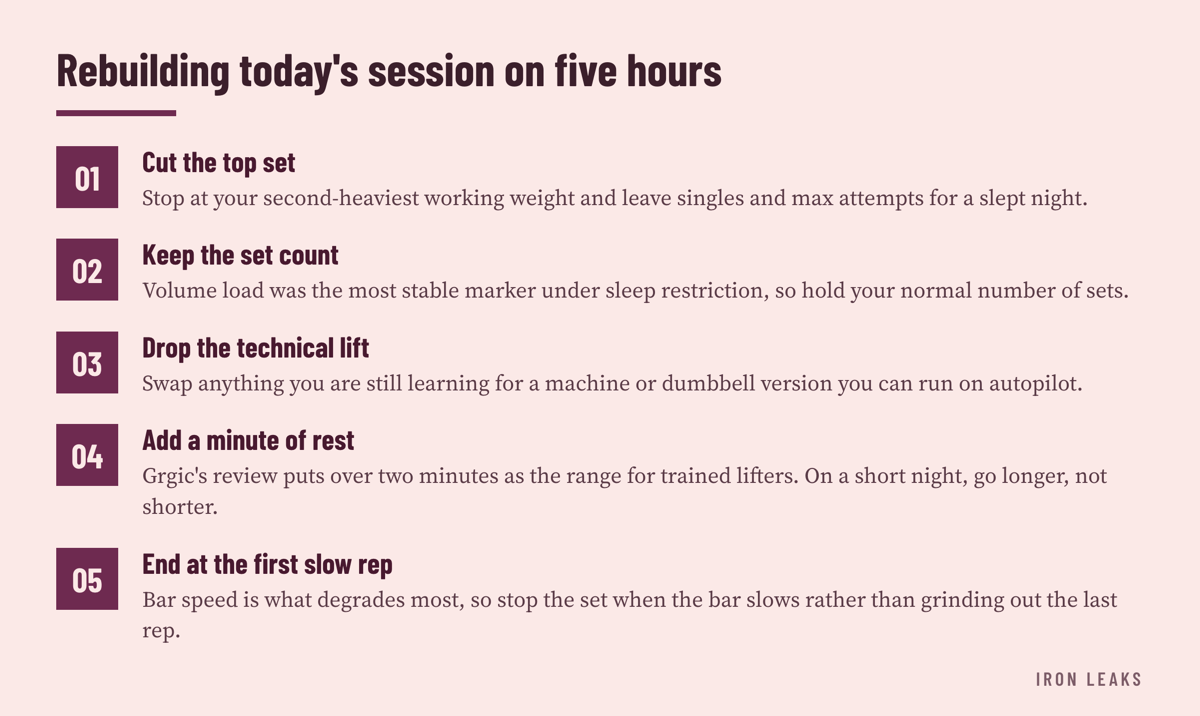
The rest interval change matters more than it sounds. Grgic and colleagues, reviewing 23 studies in Sports Medicine, concluded that rest over two minutes is needed to maximize strength gains in trained lifters. On a short night, that floor goes up, not down. Adding sixty seconds buys back some of the bar speed you lost, and the guide to resting between sets when the gym is busy covers what to do when the room will not let you. Longer rests also attract company, and our answer on whether it is rude to ask to work in on a machine tells you how to handle that without losing the interval.
What is safe to keep in the session?
Keep the set count, keep the exercise selection for anything you can do on autopilot, and keep the schedule. Volume load was the single most stable marker under restriction in the Knowles data, which means a normal number of sets at a slightly lighter load is a session you can complete without falling apart.
Keep upper-body work at full intensity. Knowles found the velocity decrement in upper-body compound lifts was not significant, while lower-body compounds took the hit. If you have a choice of what to train on a bad night, an upper-body day is the cheaper one to spend.
Keep the light conditioning if it was already scheduled. What you should not do is add cardio to compensate for a lifting session you softened. That raises internal load on a day when cortisol and training distress are already elevated.
Does the time of day matter when you are short on sleep?
It matters more than usual. Craven and colleagues found that tasks performed in the afternoon and evening were consistently impaired, while tasks performed in the morning were largely unaffected, and their conclusion was explicit: if sleep loss is unavoidable, prioritize morning exercise.
That runs against the baseline. Grgic and colleagues, in Chronobiology International, found strength is significantly higher in the evening than the morning when you are rested. The 0.4 percent per waking hour figure is what erases that advantage.
Here is the judgement call, and it is mine rather than a finding: on a five-hour night, a 7am session at 85 percent of your usual load beats a 7pm session at 100 percent. You will hit the numbers you planned instead of failing a rep at hour fourteen of being awake. Our pillar on training around a schedule that fights you covers moving a session permanently, and fitting lifting into a 12-hour shift handles the case where short nights are structural.
When should you skip the session entirely?
Skip it when you are impaired rather than tired. If you cannot drive safely, you cannot spot yourself under a bar, and no amount of session modification fixes that. Skip it if you are running a genuine sleep debt of multiple nights near zero, not one short night.
Skip the heavy squat and bench specifically if you train alone with no safety catches set. Sleep loss degrades the exact thing that saves you there, which is the ability to judge whether the next rep is going to move.
This is a training modification article, not a treatment plan. Persistent insomnia, sleep apnea symptoms or exhaustion that a normal night does not fix are questions for a clinician, not for a program change. If the reason you are hesitating is muscle soreness rather than sleep, that is a separate decision with a different answer.
Does one bad night cost you muscle?
No. Nothing in the Borba data supports it. Twenty-four adults trained for 16 sessions, one group averaging two hours below the recommended seven, and maximum repetitions, arm circumference and arm muscle area rose in both training groups while the non-training control changed nothing.
What accumulates is the internal cost. An 84 percent rise in total training distress and a 42 percent rise in cortisol area under the curve across nine nights is the reason chronic restriction feels like a plateau even when the tape measure disagrees. Knowing how much muscle six months of training should actually add is what keeps a run of bad nights in proportion.
So run the modified session, then fix the input rather than the output. The full method behind how we weight these sources is on our methodology page.
The one line to remember
Sleep restriction costs you bar speed, not workload. Keep the sets, cut the top-end load, end sets at the first slow rep, add a minute of rest, and train earlier than you normally would.
Questions readers actually ask
Should I skip the gym after only 5 hours of sleep?
No, in most cases. Craven and colleagues measured a pooled 7.56 percent performance decrement from acute sleep loss, which is a reduction rather than a wipeout. Modify the session instead: cut top-end load, keep the sets, and train earlier in the day.
What gets worse first when you lift on short sleep?
Bar speed. Knowles and colleagues found lower-body concentric velocity fell up to 15 percent under nine nights of five-hour sleep, while total volume load dropped less than 1 percent and session perceived exertion rose 11 percent.
Is it better to train in the morning or evening on short sleep?
Morning. Craven and colleagues found tasks performed in the afternoon and evening were consistently impaired while morning tasks were largely unaffected, with roughly 0.4 percent of performance lost per additional hour awake before the session.
Will short sleep stop me building muscle?
Not on its own. Borba and colleagues found that adults habitually sleeping about two hours below the recommended seven still increased maximum repetitions, arm circumference and arm muscle area across 16 resistance training sessions.
Should I lift lighter or do fewer sets on 5 hours of sleep?
Lift lighter and keep the sets. Volume load was the most stable marker under sleep restriction in the Knowles crossover trial, while maximal strength and bar velocity took the measurable hit.
Sources
- Craven et al., Sports Medicine 2022. Systematic review and meta-analysis of 227 outcome measures on acute sleep loss and physical performance, including the time-of-day and hours-awake effects.
- Knowles et al., Medicine and Science in Sports and Exercise 2022. Crossover trial of nine nights at five-hour time in bed in resistance-trained women, measuring bar velocity, volume load, perceived exertion and cortisol.
- Borba et al., Sleep Science 2024. Sixteen resistance training sessions in adults habitually sleeping one to two hours below the recommended seven, with no blunting of training gains.
- Grgic et al., Sports Medicine 2018. Systematic review of rest interval duration and chronic strength adaptation, the basis for extending rest on a short night.
- Grgic et al., Chronobiology International 2019. Meta-analysis of time-of-day resistance training, including the baseline strength advantage of evening over morning in rested lifters.
Links last checked September 7, 2026.
Every figure above is traced to a named source and re-checked on a monthly cycle. Read how we research.
Independence note. Iron Leaks takes no money from supplement brands, equipment makers or gym chains, and carries no affiliate links. Nothing here is medical advice.

Cole Brennan
Cole Brennan has trained in home gyms since 2013 and has coached lifters through the exact constraints this site is about: one pair of adjustable dumbbells, a low ceiling, a downstairs neighbour, and nobody to spot. He built Iron Leaks after watching the biggest fitness sites answer every question except the one a reader with limited equipment and limited time actually asked. He reads the primary literature rather than other people's summaries of it, and every number he publishes carries a link to where it came from. He is not a doctor and does not pretend to be one.
Keep reading
Gym Etiquette Rules for Beginners Nobody Tells You
Every etiquette listicle gives you the rule and none give you the reason. Here is the reason behind each one, so you…
Is It Rude To Ask To Work In on a Machine at the Gym?
Working in is not rude, it is the norm. The exact wording to use, what to do when the answer is no,…